TECHNOX BLOG

Insights That Drive Digital Growth

Stay ahead with expert articles on Digital Marketing, Website Development, AI, Cybersecurity, SEO, Branding, and Business Technology.

Technox Blog Banner
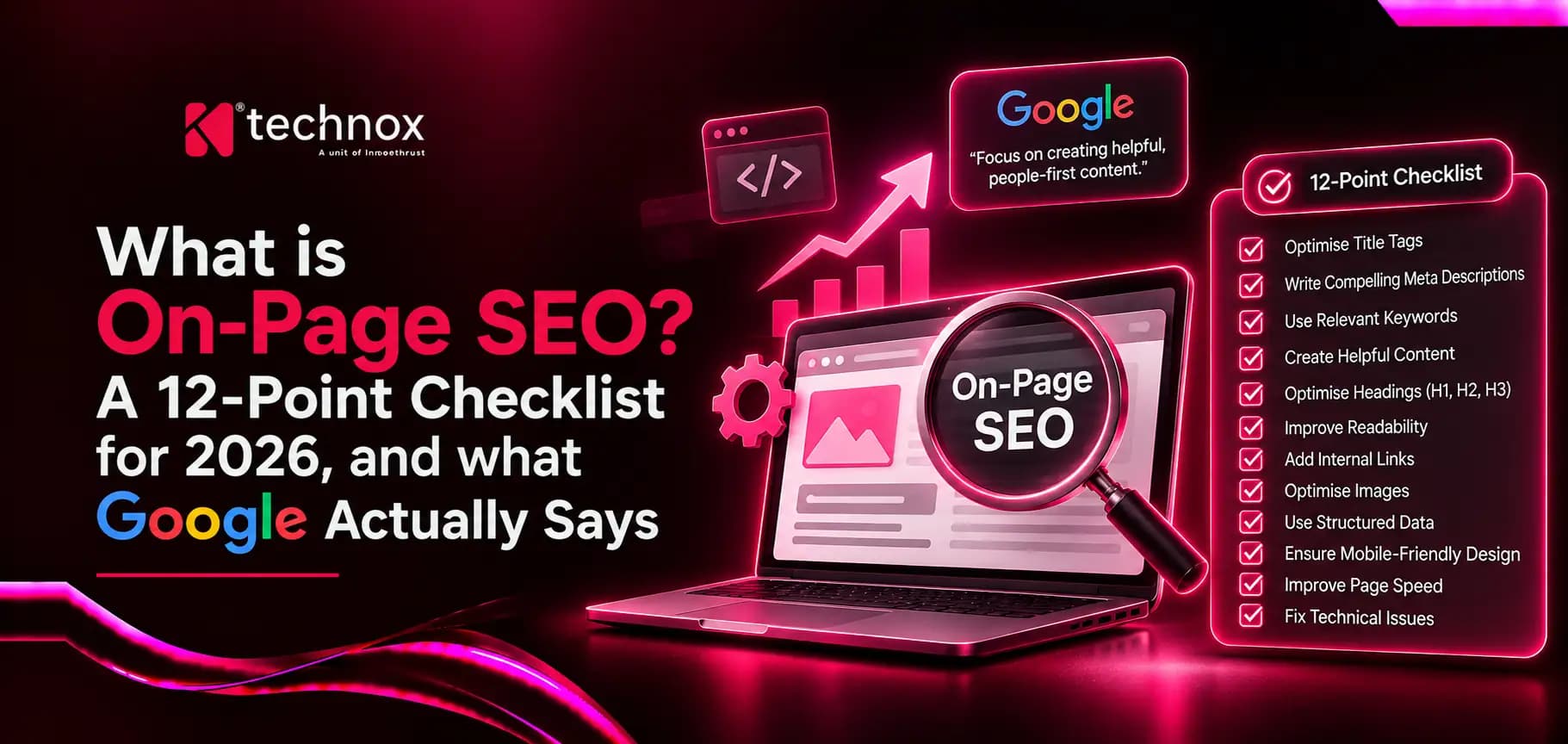
What is on-page SEO? A 12-point checklist for 2026, and what Google actually says
Lastest Blog

What is on-page SEO? A 12-point checklist for 2026, and what Google actually says

On-page SEO is everything you change on a page itself to help search engines and people understand it and choose it: the content, title tag, meta description, headings, URL, images, internal links, structured data and page experience. It is the part of SEO you fully control. Much of the advice on it is out of date: Google says it does not use the meta keywords tag, has no "optimal keyword density" and does not rank pages higher for structured data. Google's own AI search guidance also says the same on-page basics are what get pages into AI Overviews and AI Mode.  Start with one question: what is the one search this page should answer? Every on-page decision, from the title to the first paragraph to the internal links pointing at it, follows from that answer. If two of your pages answer the same search, fix that before anything else.  A note before we start: Technox sells SEO services in Coimbatore , so we have an interest in this topic. Each item below is checked against Google's own documentation or a named study, linked in the text or in Sources.  On-page vs off-page vs technical SEO  Type What it covers Examples On-page SEO What is on the page: content and the HTML elements that describe it Content, title tag, meta description, headings, URL, images, internal links, structured data Off-page SEO What other websites and people say about you Backlinks, brand mentions, reviews, Google Business Profile Technical SEO Whether search engines can crawl, render and index the site Crawlability, robots.txt, sitemaps, site speed, mobile rendering, JavaScript   Source: Technox. The lines overlap: page experience and internal links sit between on-page and technical SEO.  On-page work is usually the fastest to change and the easiest to measure, because it is all on your own site. It does not replace the other two: a perfect page that cannot be crawled, or that nobody links to, will still struggle. Some guides list four types of SEO; the fourth is usually local SEO, which uses all three to win maps and "near me" searches.  The on-page SEO checklist: 12 elements   Element What to do What Google says 1. Search intent and content Answer the search fully, from first-hand experience where you have it AI-written content is fine if it is not made "primarily to manipulate search rankings" 2. Title tag Unique, specific, front-load the topic Title elements were used "around 87% of the time" after a 2021 change 3. Meta description A short, accurate summary that earns the click Google builds snippets mainly from page content and uses the description when it fits better 4. Headings One clear H1, then logical H2s and H3s A site can rank "with or without H1 tags", and with one or many 5. URL Short, readable words, separated by hyphens "Use readable words rather than long ID numbers"; prefer hyphens to underscores 6. Images Descriptive alt text and filenames, compressed files Alt text is "the most important attribute"; filenames give "very light clues" 7. Internal links Link to the page from related pages with descriptive anchor text Every important page should be linked from at least one other page 8. Structured data Add accurate schema for eligible rich results "Structured data won't make your site rank better" 9. Page experience Meet Core Web Vitals on mobile INP replaced FID as a Core Web Vital in March 2024 10. Dates and freshness Show a clear published or updated date; update when facts change Google "doesn't depend on a single date factor" 11. Keywords Use the words your customers use, naturally No "optimal keyword density"; the meta keywords tag is not used 12. Trust signals Show who wrote it, their expertise, and who runs the site Google's guidance asks "Who" created content, "How" and "Why"   Source: Google Search Central documentation and blog posts, and statements by Google's John Mueller, linked in Sources.  The sections below explain each element and what to check.  1. Search intent and content  Content is the core of on-page SEO. Match what the searcher wants: a definition, a comparison, a price, a how-to or a local service. Google's helpful content guidance asks site owners to consider who created the content, how and why, and in its October 2026 update it warns that using generative AI to produce large amounts of text without oversight shows "little to no effort". Google's position on AI-written content itself is clear: "Appropriate use of AI or automation is not against our guidelines", but using it to generate content "primarily to manipulate search rankings" is. Since March 2024, Google treats mass-producing low-value pages as scaled content abuse, "no matter how it's created". Our guide to keyword research covers finding the intent behind a search.  2. Title tag  The title tag is still one of the strongest on-page signals, but Google often rewrites it. Google said in 2021 that title elements are used "around 87% of the time". Independent studies found more rewriting: Ahrefs found Google changed 33.4% of titles across 953,276 pages, and when it did, it used the page's H1 50.76% of the time. Zyppy found 61.6% of 80,959 titles were rewritten in early 2022. Keep titles specific, unique and close to what the page delivers, and make sure the H1 says the same thing. Our guide on how to optimise title tags and meta descriptions covers length and examples.  3. Meta description  The meta description does not directly affect rankings, but it can win the click. Google builds most snippets from the page content and uses the meta description when it describes the page better. A Portent study reported by Search Engine Journal in 2020 found Google rewrote meta descriptions about 70% of the time. Write an accurate one-to-two sentence summary anyway; when Google does use it, it is your pitch in the results.  4. Headings  Use one clear H1 that matches the page topic, then H2s and H3s that break the content into the questions readers ask. Google's John Mueller said in 2019 that a site can rank fine with or without H1 tags, and with one or many, though headings help Google understand a page's structure. Google's SEO starter guide lists the number and order of headings among the things not to focus on, saying order does not matter from a Search perspective. Headings are for structure and scanning, not for repeating keywords.  5. URL   Google's URL guidance recommends "readable words rather than long ID numbers" and hyphens rather than underscores to separate words. A URL like /services/physiotherapy-coimbatore is clearer than /page?id=4821. Google's starter guide adds that keywords in the URL path alone have "hardly any effect beyond appearing in breadcrumbs", so there is little reason to change old URLs just to add keywords.  6. Images  Google says alt text is "the most important attribute" for describing an image, and that filenames give "very light clues". It warns that "filling alt attributes with keywords" can make a site look like spam. Describe what the image shows, use a short descriptive filename such as physiotherapy-clinic-rs-puram.jpg, and compress images so they do not slow the page.  7. Internal links  Internal links tell Google which pages matter and how they relate. Google's link guidance says every page you care about should have a link from at least one other page on your site, and that anchor text should be descriptive and relevant. Link to new pages from related older ones, and avoid vague anchors like "click here". Our guide to internal linking for SEO covers this in detail.  8. Structured data  Structured data helps Google understand a page and makes it eligible for rich results, such as product details or reviews. It does not boost rankings: John Mueller said in April 2025, "Structured data won't make your site rank better." Add accurate Organization, LocalBusiness, Product, Article or FAQ markup where it fits, and make sure it matches what is visible on the page.  9. Page experience and Core Web Vitals  Google uses Core Web Vitals in its ranking systems, but says there is no single page experience signal. The three metrics and Google's targets are Largest Contentful Paint within 2.5 seconds, Interaction to Next Paint under 200 milliseconds and Cumulative Layout Shift under 0.1; INP replaced First Input Delay in March 2024. Check your pages in PageSpeed Insights or Search Console, focusing on mobile. A fast page will not outrank a better answer, but a slow one can lose visitors before they read it.  10. Dates and freshness  Google "doesn't depend on a single date factor" to judge when a page was published or updated, and it advises against future dates. Show a clear date, update the page when the facts change, and do not change the date without changing the content. Google's helpful content guidance specifically asks whether dates are being changed "to make them seem fresh when the content has not substantially changed".  11. Keywords  Use the words your customers actually search for in the title, H1, opening and naturally through the page, along with related terms and questions. Three old ideas can be dropped. Google said in 2009 that it does not use the meta keywords tag. Google's John Mueller has said there is no "optimal keyword density" and that "LSI keywords" do not exist. A Surfer correlation study of one million search results pages found exact-match keyword use showed "almost no correlation" with rankings, while pages using keyword variations throughout performed better. Surfer sells a content tool, so treat that as supporting evidence only.  12. Trust signals  Show who wrote the page and why they are qualified, who runs the business and how to contact it. Google says E-E-A-T (experience, expertise, authoritativeness and trust) is not a ranking factor in itself, but its systems look for signals that align with it, and trust matters most. Its October 2026 guidance also warns against "AI-generated headshots, made-up names, or false credentials". For a clinic or a financial service, a named, qualified author is worth more than any keyword change.  On-page SEO myths to skip  Myth What the evidence says Keyword density targets Google has no notion of optimal keyword density Meta keywords tag Google has not used it in web ranking since at least 2009 LSI keywords Google's John Mueller: there is no such thing A minimum word count Google says it has no preferred word count Schema boosts rankings "Structured data won't make your site rank better" Special on-page tricks for AI Overviews Google says there are no additional requirements for its AI features   Source: Google and statements by Google staff, linked in Sources.  On-page SEO and AI search  Good on-page SEO is also what AI search tools read. Google says there are no additional requirements to appear in AI Overviews or AI Mode, and in May 2026 it published a guide to its generative AI features that includes "Mythbusting common 'AEO/GEO' misconceptions" and explains "why SEO best practices remain relevant and foundational". Pages that answer the question clearly near the top, with facts stated plainly, are easier for both Google and AI tools to quote. Our guide to on-page AEO covers writing for AI answers.  On-page SEO for local businesses   For a Coimbatore clinic, salon or service business, add these to the checklist:  Put your name, address and phone number on the page, the same as on your Google Business Profile. Our post on NAP consistency explains why.  Create a page for each main service, and a page for each location if you have more than one.  Add LocalBusiness structured data that matches the visible details.  Mention the areas you serve naturally, such as RS Puram or Peelamedu, where it helps the reader.  Our local SEO guide covers the rest.  Where Technox fits  On-page SEO is the part of SEO with the quickest feedback loop, which is why, as an SEO company in Coimbatore, we recommend starting there: fix intent clashes between pages, rewrite titles and openings, add internal links and correct structured data, then measure in Search Console. Our SEO and AI visibility checklist shows how on-page work fits with the technical and off-page side.  If you want to start on your own, open Search Console, find a page with high impressions and a low click-through rate, and rewrite its title and first paragraph using the checklist above.  Editor's note: add one anonymised client example here, for example a page whose clicks rose after a title and content rewrite, with before-and-after Search Console numbers. Only include it if the numbers are real.  Frequently asked questions  What is on-page SEO?  On-page SEO is the work you do on a page itself to help it rank: the content, title tag, meta description, headings, URL, images, internal links, structured data and page experience. It differs from off-page SEO, which covers links and mentions from other sites, and technical SEO, which covers crawling and indexing.  What are the most important on-page SEO factors?   Google's guidance puts helpful, people-first content that matches the searcher's intent first. After that comes a clear title tag and H1, internal links from related pages and a good mobile page experience. Structured data and meta descriptions help with how the page appears in results, but Google says structured data does not improve rankings.  Is keyword density still important for on-page SEO?  No. Google's John Mueller has said Google has no notion of optimal keyword density. Use the words your customers search for naturally in the title, headings and text, and cover related questions, rather than repeating one phrase.  Which tool is best for on-page SEO?  Start with Google's free tools. Search Console shows which searches bring each page impressions and clicks, PageSpeed Insights checks Core Web Vitals, and the Rich Results Test checks structured data. Paid crawlers and content tools can speed up audits, but they report on the same elements in the checklist above.  Does on-page SEO help with AI Overviews and ChatGPT?  Yes. Google says there are no additional requirements to appear in AI Overviews or AI Mode beyond normal SEO best practices. Clear pages that answer questions early, with accurate facts, are also easier for other AI tools to read and quote.  How often does Google rewrite title tags?  It varies by study. Google said in 2021 that it uses the title element around 87% of the time. Ahrefs found Google rewrote 33.4% of titles in its 2021 study, and Zyppy found 61.6% in early 2022. A specific, accurate title that matches the H1 is the best way to keep yours. 

Read Time 14 mins
Published Nov 23, 2026
Read Article
15 alternative search engines to Google in 2026, including AI search and no-AI optionsDigital Marketing

15 alternative search engines to Google in 2026, including AI search and no-AI options

The main alternative search engines in 2026 fall into two groups: traditional engines such as Bing, DuckDuckGo, Brave Search, Ecosia, Startpage, Kagi and Mojeek, and AI search tools such as ChatGPT, Perplexity, Gemini, Copilot and Claude that answer questions directly. Many of the traditional ones are not fully independent. Yahoo's results come entirely from Bing, and DuckDuckGo largely sources its traditional links from Bing. In India, Google still handled 98.06% of searches in October 2026, according to StatCounter, but India is now ChatGPT's largest market by weekly users, according to OpenAI's India head.  Start with one question: what do you want from a Google alternative? Privacy, fewer AI summaries, an independent index, a direct answer with sources, or something else? The best choice depends on the answer, and the table below sorts the options by need.  A note before we start: Technox is a Coimbatore digital agency that sells SEO services , so we look at search engines partly from a business angle. The last section covers what these alternatives mean for businesses that want to be found.  Google still dominates, but the alternatives are growing  Search engine India share, October 2026 Worldwide share, October 2026 Google 98.06% 91.05% Bing 1.11% 4.80% Yahoo 0.35% 1.18% DuckDuckGo 0.33% 0.64% Yandex 0.10% 1.14% Ecosia 0.03% Not in top list Baidu Not in top list 0.42% These figures leave out the biggest change. ChatGPT reaches 1.2 billion people a week, as OpenAI reported in September 2026, and Google's Gemini app has 1 billion users, Sundar Pichai said in October 2026. In the US, Pew Research found about half of adults now use AI chatbots. A growing share of searching now happens outside the search engine market share tables.  The 15 alternatives at a glance  Engine Type Where results come from AI features Bing Traditional, with AI Microsoft's own index AI answers at the top of results "with links to check sources", plus an AI Mode DuckDuckGo Private Its own crawler and indexes, plus "traditional links and images... which we largely source from Bing" Search Assist and Duck.ai; noai.duckduckgo.com turns all AI features off Brave Search Private, independent index Its "own, built-from-scratch index" of 40 billion pages, with optional Google fallback mixing AI answers built on Brave's own models Ecosia Climate-focused Partners Microsoft Bing and Google, plus EUSP, a European index built with Qwant Uses "all our profits for climate action"; more than 251 million trees planted Startpage Private Results from Google under a long-standing agreement, with a stricter privacy policy, according to How-To Geek Anonymous View proxy for visiting sites Kagi Paid, ad-free Its own web and news indexes, plus anonymised calls to major search providers Kagi Assistant on paid plans Mojeek Independent index Built "from the ground up", indexing over nine billion pages Search Summary feature added in 2024 Qwant European European Search Perspective (EUSP), a European search index it is building with Ecosia Not covered here Yahoo Traditional "All algorithmic search results... are provided by Microsoft Bing" Not covered here Yandex Russian Yandex's search engine Yandex AI "finds answers combining the capabilities of a search engine and generative neural networks" ChatGPT AI search Can search the web and cite sources Answers by chat; 1.2 billion weekly users Perplexity AI search Searches the web and cites sources in its answers Answers by chat; more than 100 million monthly active users, as reported in April 2026 Gemini AI assistant Google's Gemini models Answers by chat; 1 billion users Microsoft Copilot AI assistant Built on Microsoft's Bing Answers by chat Claude AI assistant Web search with citations; Anthropic was reported to be using Brave Search in 2025 Answers by chat Google itself also offers two different ways to search. AI Mode gives conversational AI answers, and Search Live in AI Mode now works in Tamil, Bengali, Gujarati, Kannada, Malayalam, Marathi, Odia, Telugu, Urdu and more. The "Web" filter, launched in May 2024, does the opposite and "shows only text-based links".  Which alternative should you use?  If you want Try Why Fewer or no AI summaries noai.duckduckgo.com, or Google's Web filter DuckDuckGo's no-AI version turns off Search Assist, Duck.ai and AI-generated images; Google's Web filter shows only text links Privacy DuckDuckGo, Startpage or Brave Search All three are built around not tracking your searches; check each privacy policy Results not borrowed from Bing or Google Brave Search or Mojeek Both run their own indexes No ads Kagi Kagi says it has "no ads, no tracking" and is funded by users; plans start at $5 a month for 300 searches, plus tax Climate impact Ecosia Uses its profits for climate action, mostly tree planting A direct answer with sources Perplexity, ChatGPT, Claude or Copilot AI tools that search the web and cite their sources Research in Indian languages Google AI Mode or Gemini Google offers AI Mode conversations in several Indian languages How to search without AI  Searches for alternative search engines "without AI" are among the most common versions of this question. Three options work today:  Use noai.duckduckgo.com :   DuckDuckGo says it "works the same as search on duckduckgo.com, except all AI features are turned off", including Search Assist, Duck.ai and AI-generated images.  Use Google's Web filter: On a Google results page, choose "Web" from the filters, or from "More" if it is hidden. Google says it "shows only text-based links".  Choose an engine without an AI answer box: Check each engine's settings; features change often, so confirm before relying on it.  Note that a no-AI search engine removes AI-written summaries from the results page. It does not filter out websites whose content was written with AI.  Is there a good Google alternative for India?  Google's 98% share suggests most Indian users find its local results, maps and language support hard to replace. Bing is the next largest at 1.11%, and it also feeds Yahoo and much of DuckDuckGo. For research and comparison, AI tools have become the main alternative: OpenAI's India head said in November 2026 that India is ChatGPT's largest market by weekly users and that users there have doubled since January.  What alternative search engines mean for businesses  If you run a business, the useful lesson is that many engines share a few sources.  Google is still the first priority in India: With 98% of traditional searches, rankings, Google Business Profile and reviews come first. Our local SEO guide covers the basics.  Bing reaches further than its own share: Bing's index powers Yahoo, much of DuckDuckGo's links, some of Ecosia's results and Microsoft Copilot. Registering with Bing Webmaster Tools and Bing Places is a low effort for that reach. In its October 2026 earnings call, Microsoft said search and advertising revenue excluding traffic acquisition costs rose 12%, "driven by higher volume and rate across LinkedIn, Edge and Bing".  Independent indexes need crawler access: Brave and Mojeek run their own crawlers, and Brave's index also powers AI apps through its search API. Do not block crawlers you have not checked. Our guide to technical SEO for AI search visibility covers which crawlers to allow.  AI tools need to find and trust you: ChatGPT, Perplexity, Gemini and Claude answer from sources they can read and trust. Our engine-by-engine guide to AI search and our guide on getting your brand mentioned in ChatGPT, Gemini and Perplexity cover how.  Where Technox fits  For most Coimbatore businesses, the practical answer is not to chase every search engine. It is to get Google right, register with Bing, keep crawlers unblocked and make sure AI tools can find accurate information about you. As an AI SEO company in Coimbatore , that is the order we recommend.  If you want to start on your own, search for your business on Bing, DuckDuckGo and ChatGPT this week and compare what each shows with what Google shows .   Frequently asked questions  Is there a search engine without AI?  Yes. DuckDuckGo offers noai.duckduckgo.com, which turns off all of its AI features, and Google's "Web" filter shows only text-based links. A no-AI search engine removes AI summaries but does not filter out websites written with AI.  Which alternative search engines have their own index?  Brave Search and Mojeek run their own independent indexes; Brave's covers 40 billion pages and Mojeek's over nine billion. Kagi combines its own indexes with other providers. Yahoo's results come from Bing, and DuckDuckGo largely sources its traditional links from Bing.  What is the best alternative search engine in India?  For local businesses, maps and Indian languages, Google remains hard to replace, with 98% of Indian searches in October 2026. Bing is the next largest. For research and direct answers, ChatGPT, Gemini and Perplexity are the most-used alternatives, and India is ChatGPT's largest market by weekly users.  Does DuckDuckGo use Google or Bing?  DuckDuckGo says it uses its own crawler and many indexes, and that it "largely" sources its traditional links and images from Bing.  What is the best AI search engine?  It depends on the task. ChatGPT reaches 1.2 billion people a week. Perplexity is built around answers with cited sources. Gemini and Google AI Mode support several Indian languages, and Copilot is built on Bing. Check the cited sources for any answer that matters.  Is Startpage the same as Google?  Startpage shows results from Google with a privacy policy closer to DuckDuckGo's, according to How-To Geek, and offers an Anonymous View for visiting sites through a proxy. It is a private front end for Google results rather than a separate index. 

How ChatGPT picks which EdTech brands, coaching institutes and colleges to recommend to students and parentsDigital Marketing

How ChatGPT picks which EdTech brands, coaching institutes and colleges to recommend to students and parents

ChatGPT recommends the education brands it can find described clearly and consistently across the sources it reads: aggregator and review sites, community discussions, its training data and the brand's own pages. In US studies, the brand's own website is often a small share of what gets cited. Gradial found colleges were named in 35% of relevant AI answers on average, but their own websites were cited only 10.5% of the time. The audience is large: OpenAI says India is home to "the largest student population on ChatGPT globally". And in India, any results claiming an AI tool picks up from your pages is still your advertising, governed by ASCI's code for educational institutions and, for coaching institutes, the Central Consumer Protection Authority's 2024 guidelines.  Start with one question: if a parent asks ChatGPT "which is the best NEET coaching in Coimbatore?" or "is [your brand] good for JEE?", what does it say about you, and which websites does it cite? That answer shows whether AI tools know your brand, trust it, or confuse it with someone else.  A note before we start: Technox sells AI SEO services in Coimbatore , so we have an interest in this topic. The research below is linked in each section. Most of it comes from the US, because no comparable citation study for Indian education queries has been published that we could verify; we say where that matters.  Students and parents are already asking AI before they enquire  The shift is not limited to students, and India is at the centre of it.  Finding Who Sample India is home to "the largest student population on ChatGPT globally" OpenAI, August 2025 OpenAI usage data Indian users are "nearly 2x above" the global median for questions about education and learning; users aged 18 to 34 send about 80% of India's consumer ChatGPT messages OpenAI Signals, February 2026 Consumer usage data, November 2025 46% of US high school students use AI tools such as ChatGPT in their college search, up from 26% in spring 2025; 18% dropped a college based on AI results EAB, February 2026 5,000+ US high school students 57% of US parents of high schoolers have used AI tools to evaluate colleges; 34% found schools they had not considered EAB, August 2026 2,515 US parents 75% of study-abroad applicants on its platform use AI tools to research programmes and courses Leap Scholar, December 2025 Platform data and surveys; sample for this figure not stated   The big AI companies are also courting Indian students directly. Google offered students in India aged 18 and over a free one-year Google AI Pro plan in July 2025, and in January 2026 added full-length JEE mock exams to Gemini built on "vetted content from Indian education firms Physics Wallah and Careers360", as TechCrunch reported. OpenAI made ChatGPT Go free for a year for users in India who signed up from 4 November 2025. Content from two Indian EdTech brands is now built into Gemini; most others are competing to be mentioned in its answers.  What AI tools cite for education questions  The studies disagree on details, which is itself useful: each AI tool leans on different sources.  Study Main finding Scope Gradial, June 2026 When AI tools cited a source for college questions, "the source is rarely a .edu domain"; Niche, Wikipedia, CollegeVine, U.S. News and Reddit were cited most 51 US colleges, 20 queries each, 7 AI tools Temso, October 2026 ChatGPT drew 45% of its university citations from institutions' own sources, against 6% for Copilot; user-generated content was 25% of AI Overview citations against 4% for ChatGPT 126,683 responses, 546,189 citations, 12 countries, not India 5W PR EdTech Index, updated November 2026 Brand sites were 58.2% of citations across four AI tools; community and social sources were 4.2% overall but 28.8% in Google AI Overviews; Khan Academy was named in 41.7% of answers 288 answers from ChatGPT, Claude, Gemini and Perplexity, plus AI Overviews, on one day The Funnel Story and ThinkPivot, May 2026 47.6% of 225 Indian institutions had no JSON-LD structured data, and 15.6% served pages that need JavaScript to show content Site audit of 225 Indian institutions, not a citation study   Two lessons hold across the data. First, your own site matters most on some platforms, such as ChatGPT in Temso's data, and much less on others. Second, Google's AI Overviews lean far more on community sources than the chat tools do. For Indian education brands, the equivalent third-party sources are the aggregators and review sites students already use, such as Shiksha, Careers360 and Collegedunia, along with Quora, Reddit, YouTube and Google reviews. Check which of these AI tools cite for your own category before deciding where to spend effort.  How AI tools decide which brand to recommend  AI tools do not have a list of approved institutes. They build an answer from what they can find, so a brand gets recommended when several sources agree on who it is, what it offers and how good it is.  The tool has to recognise your brand. A coaching institute with three slightly different names across its website, Google Business Profile and aggregator listings is harder to identify. Our guide to entity SEO covers how to fix this.  It has to find specific facts. Fees, course duration, batch dates, eligibility, mode of teaching, faculty and results are what students and parents ask about. Pages that state them plainly can be quoted.  It looks for agreement from other sources. Reviews, aggregator profiles, news coverage and student discussions confirm or contradict what you say about yourself. Our guide on getting your brand mentioned in ChatGPT, Gemini and Perplexity covers earning these.  It has to be able to read your pages. Several AI tools' fetchers do not run JavaScript, so a course page that shows fees only after scripts load may look empty to them. Our guide to technical SEO for AI search visibility covers the checks.  What to publish so AI tools can describe you accurately   Page or asset What it should contain Indian rule to keep in mind Course or programme pages Fees, duration, eligibility, mode, batch dates, syllabus and refund policy CCPA guidelines treat false claims about course, duration, faculty credentials, fee or fee refund as misleading Results or outcomes page Results from the latest completed academic year, with totals and evidence ASCI: placement and rank claims must be "of the latest completed academic year and substantiated with evidence", and placement numbers must state the total number of students passing out Topper and alumni stories Name, rank, course attended and whether it was paid, with the student's consent CCPA: disclose the rank, course name and duration and whether it was paid; consent must be "taken subsequent to the selection" Faculty pages Names, qualifications and subjects Credentials must be accurate under the CCPA guidelines Parent and student FAQs Fees, safety, hostel, recognition, timings and refunds in plain answers Avoid guarantees; ASCI bars 100% claims on abstract things, such as "100% Placement/Job assistance" Aggregator and Google Business Profile listings The same name, address, courses and fees as your site Inconsistent listings can confuse both AI tools and parents Our guide to on-page AEO shows how to write these pages so the key facts sit where AI tools look first.  Results claims: what AI repeats is still your advertising  The CCPA is actively enforcing its rules. As PTI reported in May 2026, the CCPA had issued "more than 60 notices to coaching institutes" and imposed "penalties totalling over Rs 1.39 crore on 31 institutes", including Rs 10 lakh on Motion Education and Rs 5 lakh on Career Line Coaching in Sikar. In February 2026 it fined Vajirao and Reddy Rs 15 lakh, its second penalty, over a claim of "over 645 selections out of 1,016 vacancies".  ASCI's education guidelines add that any claim of rank, marks or jobs must carry the disclaimer "past record is no guarantee of future prospects", in a font no smaller than the claim.  This matters for AI visibility in a practical way. If your old pages still carry inflated or out-of-date results, AI tools can find and repeat them, and a parent may read them as current. Clean up old claims before trying to get more of your content quoted.  Students and parents ask different questions  Build your prompt set around both audiences. A student may ask about course fit, difficulty, teaching quality and what other students say; a parent may focus on fees, safety, recognition, results and refund terms. EAB's US data shows parents use AI for evaluation as much as students do, with 57% having used AI tools to compare colleges. Test questions such as these for your brand:  "Best NEET coaching in Coimbatore for a repeater?"  "Is [your brand] good for JEE Advanced?"  "[Your brand] vs [competitor] fees and results"  "Is [course or university] recognised by UGC or AICTE?"  "Safe hostels near [your institute] for girls?"  The answers will show which facts AI tools have about you and which sources they trust. If a recognition question returns uncertain answers, make the approval details easy to find on your site. As of February 2026, UGC's list named 32 fake universities, so parents have reason to check.  How to measure your visibility  Run a fixed set of 20 to 40 student and parent questions through ChatGPT, Gemini, Perplexity and Google's AI Mode every month, in English and in the languages your students use. Run each question several times, because answers vary. Record whether you are named, whether you are cited, which sources are cited and whether the facts are correct. Track enquiries from AI tools in Google Analytics 4 as well. Our guide on how to measure AI visibility covers the set-up.  Where Technox fits  For education brands, AI visibility and advertising compliance are now the same project: the pages that get quoted are the pages a regulator can read. As an SEO company in Coimbatore , our advice to education brands is to start with an audit of what AI tools say about them, then tidy up listings and results pages, then publish the course and parent information AI tools can quote accurately. Final claims should still be checked against the ASCI and CCPA rules by whoever signs off your advertising.  If you want to start on your own, ask ChatGPT and Gemini the five questions above about your institute this week and save the answers. Fix anything wrong at its source first.  Frequently asked questions  How does ChatGPT decide which EdTech brand to recommend?   ChatGPT builds answers from the sources it can find, including aggregator and review sites, community discussions, its training data and brand websites. Brands that are described clearly and consistently across these sources, with specific facts such as fees, courses and results, are easier to recommend.  Do students and parents in India really use ChatGPT to choose courses?  Yes. OpenAI says India has the largest student population on ChatGPT globally, and Indian users ask about education and learning nearly twice as often as the global median. Leap Scholar reported that 75% of study-abroad applicants on its platform use AI tools to research programmes.  Which websites does ChatGPT cite for education questions?  It varies by tool. In US studies, Gradial found aggregators such as Niche, Wikipedia and U.S. News cited most for college questions, while Temso found ChatGPT drew 45% of its university citations from institutions' own sources. No comparable study of Indian education queries has been published that we could verify.  Can a coaching institute claim toppers and results in content AI might quote?   Yes, but the same rules apply as in any advertising. ASCI requires results claims from the latest completed academic year with evidence, and the CCPA's 2024 guidelines ban false claims about selections or ranks and require disclosures and consent for topper photos and names. The CCPA had penalised 31 coaching institutes by May 2026.  Does structured data help education brands appear in AI answers?  It helps AI tools and search engines identify your organisation and courses, but it is not enough on its own. An audit of 225 Indian institutions found 47.6% had no JSON-LD structured data at all, so adding accurate Organization and Course markup is a basic step that many have not taken.  Should parents trust what ChatGPT says about a college or coaching institute?  Treat it as a starting point. AI answers can be outdated or mix up institutions with similar names. Check recognition on official UGC or AICTE sources, and confirm fees, results and refund terms directly with the institute. 

How to optimise your ecommerce store for AI shopping: ChatGPT, AI Mode, Copilot and Perplexity in 2026Digital Marketing

How to optimise your ecommerce store for AI shopping: ChatGPT, AI Mode, Copilot and Perplexity in 2026

To get your products into AI shopping answers, give each platform clean product data in the format it reads: Google Merchant Center for AI Mode and Gemini, a product feed or Shopify Catalog for ChatGPT, and Microsoft Merchant Center for Copilot, backed by a site AI tools can crawl. Buying inside the AI is a separate step, and in 2026 it is still mostly limited to the US. OpenAI scaled back its in-chat Instant Checkout in March 2026, and Google's agentic checkout covers select merchants in the US, Canada and Australia. For an Indian store, being recommended is open today; selling inside the chat is at the test and pilot stage.  Start with one question: is your goal to be recommended by AI tools, or to be bought inside them? For most Indian stores in late 2026, the first is achievable now and the second means watching pilots and preparing your data.  A note before we start: Technox builds ecommerce websites in Coimbatore , so we have an interest in this topic. This post covers the platforms, programmes and setup. For the strategy behind AI product recommendations, such as reviews, structured data and brand mentions, see our guide to ecommerce AI SEO .  Discovery and checkout are two different things  Most guides blur these together. Discovery means your product appears when someone asks an AI tool for a recommendation. Checkout means the shopper pays without leaving the AI. Each platform handles them differently.  Platform How products get in Checkout inside the AI India status, November 2026 ChatGPT Product feeds through OpenAI's Business Hub, Shopify Catalog, or providers such as Salesforce and Stripe, plus "other available retail and public web sources" Merchants now use their own checkout; ChatGPT Wallet can pay on your website No India-specific shopping statement found; a UPI agentic payments pilot with BigBasket was announced in October 2025 Google AI Mode and Gemini The Shopping Graph, with Merchant Center as the direct route for your product data Universal Commerce Protocol (UCP) checkout, for select merchants with products eligible in the US, Canada and Australia Google says it is partnering with Flipkart; TechCrunch reported a limited Buy button test on Flipkart listings in September 2026 Microsoft Copilot Microsoft Merchant Center feeds "help inform organic Copilot results" Copilot Checkout, rolling out in the US from January 2026 No India statement found Perplexity Shopping results, with PayPal merchants discoverable through Instant Buy Instant Buy through PayPal, for US users No India statement found Shopify (any channel) Agentic Storefronts syndicate one product setup to ChatGPT, Copilot, AI Mode and Gemini Depends on the channel Not confirmed for Indian stores The pattern is clear. Every platform reads product data now. Checkout inside the AI is a US-first feature everywhere, and India is at the pilot stage.  Why it is worth doing now  AI shoppers are a small share of traffic, but they arrive ready to buy.  Adobe: AI traffic to retail sites in the 2025 holiday season (November to December) rose 693.4% from the year before, and AI referrals converted 31% better than other traffic sources. Adobe's data covers visits to US retail sites.  Salesforce: in the 2025 holiday season, shoppers referred by AI search converted "nine times more often" than shoppers from social media, across data from more than 1.5 billion shoppers worldwide.  NielsenIQ, India: 92% of consumers surveyed in eight Indian metros had used AI while shopping, 79% had used ChatGPT and 72% Gemini. NielsenIQ does not publish the sample size on its summary page, so treat this as directional.  Adobe's figures are from the US and Salesforce's are global. We found no published India-specific conversion data for AI shopping.  Step 1: Get your product data right, because every platform reads it  Product data is the one piece of work that helps on every AI platform.  Set up Google Merchant Center free listings: Eligible products can appear in "Search, Images, Lens, YouTube, Gemini, the Shopping tab" and more at no cost. Google's AI Mode draws on the Shopping Graph, which holds "more than 50 billion product listings, 2 billion of which are updated every hour".  Prepare a ChatGPT product feed if you are not on Shopify: OpenAI's feed spec asks for "the nine required fields" of basic product data plus target_countries and store_country, delivered by manual upload, a hosted HTTPS URL or SFTP. You verify your business in OpenAI's Business Hub first.  Join Microsoft Merchant Center: Microsoft says its feeds "help inform organic Copilot results", even though they are not required for Copilot Checkout.  Keep price and stock accurate everywhere: ChatGPT says merchants are ranked "based on factors like availability, price, quality". A feed that says in stock when you are sold out costs you twice: in the AI answer and with the customer.  Use stable product IDs and full attributes: Size, colour, material, GTIN where you have one, and clear images. AI tools compare products in these fields.  Step 2: Make your store readable to AI tools and agents  Feeds are not the only source. OpenAI says ChatGPT uses feeds and "other available retail and public web sources", and that its browser lets ChatGPT "visit your site on a customer's behalf". If your CDN blocks AI crawlers, or your prices load only through JavaScript, AI tools may see an incomplete store. Our guide to technical SEO for AI search visibility covers the checks, and the Shopify SEO checklist covers Shopify-specific settings.  Step 3: Join the programmes you qualify for  Which route applies depends on your platform and where you sell.  Your store runs on Route into ChatGPT Route into Google, Copilot and Perplexity Shopify OpenAI says Shopify product data is "already integrated into ChatGPT through Shopify Catalog"; Razorpay says Shopify stores can be "app-ready in under 30 minutes" on its ChatGPT app route Merchant Center and Microsoft Merchant Center feeds; Shopify's Agentic Storefronts where available for your store WooCommerce or custom Direct product feed through OpenAI's Business Hub, or Razorpay Webstore, which Razorpay says lets D2C brands without Shopify submit a ChatGPT app "with our support" Merchant Center and Microsoft Merchant Center feeds from a plugin or your own export No online store Shopify's Agentic plan lists products in Shopify Catalog with "no Shopify online store required" and no monthly fee Shopify Catalog syndication, where available For Indian payments inside AI tools, the activity is in pilots. Razorpay, NPCI and OpenAI announced agentic UPI payments on ChatGPT in October 2025, "Currently in the pilot stage", with BigBasket among the first merchants. Google's test of a Buy button on select Flipkart listings in Gemini and AI Mode was "limited to some users and a small selection of products". Prepare your data now so you are ready when these open up.  Step 4: Know the difference between organic results and ads  OpenAI says ChatGPT product results "are selected independently by ChatGPT and are not ads, nor influenced by any OpenAI partnerships", and that "Ads are separate from product results". ChatGPT ads arrived in India in August 2026 for logged-in adults on the Free and Go plans, with daily budgets starting at ₹725, as Inc42 reported. Paying for ads will not change your organic product ranking, so fix the data first and treat ads as a separate test.  Step 5: Measure AI shopping traffic separately  Set up a separate view of AI referral traffic and revenue. Google Analytics 4 groups visitors from ChatGPT, Gemini, Copilot and similar tools into an "AI Assistant" channel, though it excludes Google's AI Overviews and AI Mode. Track revenue and conversion rate for that channel, not just sessions, and run a fixed set of product questions through each AI tool every month. Our guide on how to measure AI visibility covers the set-up.  What an Indian store should do this quarter  Fix your Merchant Center feed and claim free listings.  Check that AI crawlers can reach your product and category pages.   Add complete Product structured data with price, availability and reviews on every product page.  Choose your ChatGPT route: Shopify Catalog if you are on Shopify, or a direct feed or Razorpay Webstore if you are not.  Set up AI referral tracking in GA4 before traffic grows.  Watch the pilots. UPI agentic payments and Google's Flipkart test are the signals that in-chat buying is coming to India.  Where Technox fits  Most AI shopping guides are written for US stores and assume in-chat checkout is available. For Indian brands, the work that pays off today is product data, crawlable product pages and tracking, and the same work prepares you for checkout when it arrives. As a Shopify development company in Coimbatore , we build Shopify, WooCommerce and custom stores with structured data and optimized product pages, the foundation of every AI shopping platform.  If you want to start on your own, ask ChatGPT, Gemini and Perplexity for the best product in your category this week, note which stores they recommend, and compare their product data with yours.  Frequently asked questions  Can I sell on ChatGPT from India?  Your products can appear in ChatGPT's results through a product feed, Shopify Catalog or a partner such as Razorpay. Paying inside ChatGPT with UPI is still a pilot: Razorpay, NPCI and OpenAI announced agentic UPI payments in October 2025 at the pilot stage. Most purchases still finish on your own website.  Does ChatGPT Instant Checkout still exist?  Not in its original form. In March 2026 OpenAI said the first version of Instant Checkout "did not offer the level of flexibility" it wanted and began "allowing merchants to use their own checkout experiences". Shoppers can still use ChatGPT Wallet to pay on a merchant's website.  Is it free to get products into ChatGPT and Google AI Mode?  Google Merchant Center free listings can appear in Search, Gemini and the Shopping tab at no cost. OpenAI says ChatGPT product results are not ads, and we found no fee for submitting a product feed. Ads on both platforms are separate and paid.  How do products get into Google AI Mode?  AI Mode shopping is powered by Google's Shopping Graph, and Merchant Center is how you give Google your product data directly. Keeping your Merchant Center feed complete and accurate is the main step. Checkout inside AI Mode is available only to select merchants with products eligible in the US, Canada and Australia.  How does ChatGPT choose which products to show?   OpenAI says a product appears "when ChatGPT perceives it to be relevant to your intent", using structured data from first-party and third-party providers, and that merchants are ranked on factors like availability, price and quality. Results are not influenced by ads or OpenAI partnerships.  Do I need Shopify to appear in AI shopping results?  No. WooCommerce and custom stores can submit feeds directly to Google Merchant Center, Microsoft Merchant Center and OpenAI. Shopify makes it simpler through Shopify Catalog, and Shopify's Agentic plan lets brands without a Shopify store list products in that catalogue. 

LLM SEO services: what they include, what they cost in India and how to choose an agencyDigital Marketing

LLM SEO services: what they include, what they cost in India and how to choose an agency

LLM SEO services: what they include, what they cost in India and how to choose an agency  LLM SEO services are the work an agency does to get your business named and cited in answers from AI tools built on large language models, such as ChatGPT, Gemini, Perplexity, Copilot, Claude and Google's AI Overviews. Most of that work is good SEO done with AI answers in mind. Search Engine Land reported that Google's Gary Illyes said normal SEO is all you need to rank in AI Overviews. What a good LLM SEO service adds is measurement across AI tools and earned mentions on other websites. What a bad one adds is a promise nobody can keep: in a SparkToro study, there was less than a 1 in 100 chance that ChatGPT or Google's AI would give the same list of brands in any two answers to the same question.  Start with one question: if you ask ChatGPT and Gemini today for the best [your service] in Coimbatore, is your business named? If you do not know, the first thing to buy is a check, not a retainer.  A note before we start: Technox sells AI SEO services in Coimbatore , and our prices appear later in this post, so we have an interest in this topic. We have tried to write the guide we would want a client to read before talking to any agency, including us.  LLM SEO means optimising for answers from large language models  LLM stands for large language model, the technology behind ChatGPT, Gemini, Claude and the AI answers in Google and Bing. LLM SEO is one of several names for the same field, alongside GEO, AEO and LLMO. Our post on SEO vs AEO vs GEO vs LLMO explains where each term came from.  The audience in India is now large enough to matter for most businesses:  ChatGPT: India has 100 million weekly active users, and Sam Altman has called India ChatGPT's second-largest user base after the US (TechCrunch, February 2026).  Google AI Mode: expanded in October 2025 to Bengali, Kannada, Malayalam, Marathi, Tamil, Telugu and Urdu.  Perplexity: monthly active users in India peaked at about 22 million and stood at nearly 14 million in July 2026, according to Sensor Tower estimates reported by TechCrunch.  Is LLM SEO just SEO with a new name? Largely, yes. Microsoft's rewritten Bing Webmaster Guidelines now name generative engine optimization and, as Search Engine Journal reports, note that it does not guarantee citations, just as SEO does not guarantee rankings. The difference is in what gets measured and how much off-site work is needed, not in a separate set of secret techniques.  What a real LLM SEO service should include  A complete service covers six areas. If an agency's proposal skips one, ask why.  Workstream What it involves What you should receive AI visibility baseline Running a fixed set of customer questions through each AI tool, several times each The prompt list, the platforms, the number of runs and the starting results Technical access Checking that AI crawlers are not blocked by your CDN, firewall or robots.txt, and that key content is readable without JavaScript A crawl and access report with fixes Entity and structured data Making sure AI tools can identify your business: consistent name, details, Organization schema and linked profiles Schema in place and a list of profiles corrected Answer-ready content Pages that answer your customers' real questions clearly, with facts AI tools can quote Pages created or rewritten, with the questions each one answers Earned mentions Getting your business named on trusted third-party sites: local news, directories, associations, reviews A list of placements earned, with links, and none paid for without disclosure Measurement Tracking mentions, citations and AI referral traffic over time A monthly report from first-party data and repeated prompt runs   Our guides on technical SEO for AI search , entity SEO and getting your brand mentioned in AI answers cover these workstreams in more depth.  Two first-party data sources should appear in every report. Google Analytics 4 has an "AI Assistant" channel for visitors "from sources like ChatGPT, Gemini, Deepseek, Copilot, or Grok", though it "excludes Google's AI Overviews and AI Mode". Microsoft's AI Performance dashboard, in Microsoft Advertising, shows "how often their content is cited in generative answers" and which URLs are referenced. Our guide on how to measure AI visibility covers both, plus Search Console.  What LLM SEO services cost in India  There is no reliable survey of LLM SEO prices in India yet. These are the best data points we could find.  Source What it shows Scope Backlinko pricing survey, 2025 SEO under $500 a month is "primarily available in emerging markets like India/Latin America (42% of providers)", against 7% of providers in the US, UK and Australia 300+ SEO professionals worldwide SE Ranking agency survey, 2024 to 2026 Agencies with set or planned prices for AI Overview optimisation charge "an average monthly fee of around $937"; 64% of agencies charge under $1,000 a month for SEO 260 agencies, mostly small; not India-specific SEO Discovery, India Published LLM SEO plans starting at $250 a month, up to $500 a month One agency's price list Technox, Coimbatore AI SEO from ₹15,000 a month (starter), ₹35,000 (GEO and AEO) and ₹60,000 (combined with full SEO) Our own starting prices   Tracking tools also cost money, and an agency's fee has to cover them. Semrush's AI Visibility Toolkit costs $99 a month, and Perc AI starts at $95 a month for 50 prompts. A quote far below these tool costs may not include proper tracking.  What should decide the price is scope: how many locations, how many platforms, how many prompts are tracked, and how much content and outreach is included each month. Ask for those numbers in writing. A "₹5,000 LLM SEO package" and a "₹1 lakh LLM SEO retainer" can describe completely different work.  No one can guarantee you a place in AI answers  AI answers change constantly, which is why any guarantee is a warning sign.  Lists change on almost every run: In a January 2026 SparkToro study run with Gumshoe.ai, an AI tracking startup, 600 volunteers ran 12 prompts through ChatGPT, Claude and Google's AI 2,961 times. There was "a <1 in 100 chance" of getting the same list of brands twice, and SparkToro warned that AI visibility "experts" could "weaponize" this. "Buyer beware."  AI Overviews keep rewriting themselves: Ahrefs tracked more than 43,000 keywords and found AI Overview content changed 70% of the time, with 45.5% of citations changing at each update and content changing every 2.15 days on average.  The platforms say so: The Bing guidelines state that GEO does not guarantee citations.  What an honest agency can promise is the work, the measurement method and regular reporting. A useful result looks like "named in 40% of 50 tracked prompts, up from 10%", measured over many runs, not "we will get you into ChatGPT".  How to vet an LLM SEO agency: eight questions to ask  Can I see the exact prompts you will track, and how many times each is run? A visibility score without the prompt list behind it cannot be checked.  Which AI platforms do you track, and why those? The answer should match where your customers search.  Do you measure mentions and citations separately? Being named and being linked are different results with different values.  What first-party data will you report? Look for GA4 AI referrals, Bing's AI performance data and Search Console, not only a vendor dashboard.  How do you earn mentions on other websites? If the answer involves paying for placements, ask where and whether they are disclosed.  What will this do to my Google rankings? LLM SEO that damages organic search is a bad trade, because many AI answers, including Google's own, draw on search results.  Who owns the content, schema and accounts? Everything created for you should stay with you if you leave.  What are the minimum term and exit terms? In our view, three to six months is a reasonable first test. Long lock-ins before any results are not.  Red flags that should end the conversation  Red flag Why it matters Guaranteed rankings or citations in ChatGPT or AI Overviews AI answers change on almost every run; Bing's guidelines say GEO does not guarantee citations Paid mentions sold as "AI PR" A Search Engine Land article documents mentions sold on private blog networks at around 10 to 15 times the cost of a typical backlink, and Reddit posts from aged accounts that are often removed within 30 days Hidden text or instructions aimed at AI tools In OtterlyAI's test, some AI tools read hidden text, but no platform followed hidden instructions and Copilot flagged them as unsafe; Bing's guidelines now have a full section on prompt injection llms.txt sold as the main deliverable Search Engine Land reported that Google's Gary Illyes said Google will not crawl or use llms.txt files A single "AI visibility score" with no prompt list It cannot be checked or compared The agency ranks itself first in "best LLM SEO agencies in India" lists Several such lists are published by one of the agencies listed, sometimes without saying so   For clinics and other regulated businesses, there is one more check. In its 2025-26 report, the Advertising Standards Council of India found that 90% of the 639 beauty and personal care ads it processed needed changes, and that the most common violations were "claims of visible, rapid, or guaranteed results, such as skin transformation, hair growth". Content an agency writes to win AI mentions for your clinic must follow the same rules.  Should you hire an agency or do it yourself?  A single-location business with a good website, an accurate Google Business Profile and steady reviews can do much of the groundwork itself. Our guide on how to optimize for AI search engines covers the steps. Hiring makes more sense when you have several locations, an e-commerce catalogue, strong competitors already named in AI answers, or no time to earn coverage on other websites.  Where Technox fits  We publish our starting prices because we think buyers should not have to ask. As an SEO company in Coimbatore , our AI SEO work starts with a free AI visibility audit and a fixed quote for the work that the audit shows is needed. Ask us for the prompt list behind any result we report. We do not guarantee placements, because no one honestly can.  If you want to start on your own, write down ten questions your customers ask before buying, run them through ChatGPT, Gemini and Perplexity this week, and note whether you are named. That list is also the first thing to show any agency you talk to.  Frequently asked questions  What is LLM SEO?  LLM SEO is the work of getting a business named and cited in answers from AI tools built on large language models, such as ChatGPT, Gemini, Perplexity, Copilot, Claude and Google's AI Overviews. It builds on standard SEO and adds tracking of AI answers and earning mentions on other websites.  What is the full form of LLM in LLM SEO?  LLM stands for large language model, the type of AI that powers tools like ChatGPT, Gemini and Claude. LLM SEO means search engine optimization for answers generated by these models.  How much do LLM SEO services cost in India?  There is no reliable India-specific survey. Published prices range from about $250 a month at one Indian agency to ₹60,000 a month or more for combined AI and full SEO. Globally, SE Ranking found agencies charging an average of around $937 a month for AI Overview optimisation. Ask for the number of prompts, platforms and deliverables behind any price.  Can an agency guarantee my business will appear in ChatGPT?  No. SparkToro found less than a 1 in 100 chance that ChatGPT or Google's AI would return the same list of brands twice for the same question, and Bing's guidelines say GEO does not guarantee citations. An agency can commit to the work and to transparent measurement, not to placement.  Is LLM SEO different from SEO?  Mostly no. Search Engine Land reported that Google's Gary Illyes said normal SEO is enough to rank in AI Overviews. The differences are in measurement across AI tools and in the extra weight on mentions from other websites.  How long does LLM SEO take to show results?  There is no independent data on this. AI answers can change within days, and Ahrefs found AI Overview content changed every 2.15 days on average, so early movement is possible but unstable. Judges progress over three to six months using repeated prompt runs, not a single check. 

Answer engine optimization strategies: 12 tactics ranked by the evidenceDigital Marketing

Answer engine optimization strategies: 12 tactics ranked by the evidence

The answer engine optimization strategies with the strongest evidence are the unglamorous ones: make sure AI crawlers can read your pages, rank well in normal search, keep your business listings accurate and put the answer early on the page. Several of the most popular tactics have little or no evidence behind them. Google's own guide to its AI search features, as Search Engine Journal reported in May 2026, says site owners can ignore llms.txt files, content "chunking" and special schema. Answer engine optimization (AEO) is the work of getting your content used and cited in AI-generated answers from tools such as Google's AI Overviews and AI Mode, ChatGPT, Perplexity, Gemini and Copilot.  Start with one question: when your customers ask an AI tool about your service today, does the answer use your content, name your business, or neither? Before spending on any tactic below, find out where you stand.  A note before we start: Technox sells AI SEO services in Coimbatore , so we have an interest in this topic. Most AEO guides list tactics without saying how well each one is supported. We graded each one, and we link the evidence so you can judge it yourself.  How we graded the evidence  Grade What it means Strong Supported by platform documentation or by independent tests that agree Moderate Supported by large studies that point the same way, but mostly correlation or vendor data Weak Mixed results, small samples or no clear effect Myth The best available evidence points against it Most AEO data comes from companies that sell SEO or AI visibility tools, and most of it shows correlation, not cause. A 2026 review of 45 studies on generative engine optimisation concluded that "no reviewed technique shows a stable, longitudinal, cross-platform causal effect" on being discovered. Treat every grade below as the best current reading, not a law.  The 12 strategies at a glance  Strategy Evidence grade Best evidence 1. Let AI crawlers read your pages Strong Independent tests found ChatGPT, Claude, Gemini and Perplexity fetchers did not run JavaScript 2. Rank well in normal search Strong for AI Overviews, moderate for other tools seoClarity: position-one URLs cited in AI Overviews 43% of the time 3. Keep your business profile and listings accurate Strong for local businesses BrightLocal: Google Business Profile was 28.5% of local AI citations 4. Put the answer early, in definite language Moderate Surfer: 38% of AI Overview citations came from a page's first 100 words 5. Research the questions behind the question Moderate Google describes AI Mode running several related searches for one question 6. Earn mentions on third-party sites Moderate Yext: 42% of AI citations came from listings, 8% from reviews and social 7. Keep content fresh Moderate Ahrefs: AI-cited URLs were 25.7% fresher than organic results 8. Add statistics, quotes and sources Moderate in the lab, weak in practice 30% to 40% gains in a controlled study; a later review says they do not prove real-world effects 9. Add structured data Weak for Google, some support for Bing Ahrefs test: no clear citation lift after adding schema 10. Measure with repeated prompt runs Strong Researchers found single runs give "a misleadingly precise picture" 11. Publish an llms.txt file Myth for visibility Ahrefs: 97% of llms.txt files got zero requests in a month 12. Chunk pages and write to a word count Myth Ahrefs: almost no correlation between length and AI Overview citations 1. Let AI crawlers read your pages (strong)  If an AI tool cannot read your content, nothing else on this list matters. In a January 2026 test by RESONEO, the fetchers used by ChatGPT, Claude, Gemini and Perplexity showed "No execution" of JavaScript, while Bing Copilot showed "Full execution". An earlier Vercel and MERJ study found the same for ChatGPT and Claude crawlers. If your prices, services or answers only appear after JavaScript runs, several AI tools may never see them. Check your CDN and firewall settings too, since they can block AI crawlers without anyone noticing. Our guide to technical SEO for AI search visibility covers the checks.  2. Rank well in normal search (strong for AI Overviews, moderate elsewhere)  Google's AI answers lean on its search results. seoClarity found URLs ranking in position one were cited in AI Overviews 43% of the time, with the rate falling as rankings drop. But ranking is not enough on its own: in AI Mode, seoClarity's study of 1,000 transactional US queries found the top 10 results overlapped with citations for only 28% of queries, and just 19% of 12,011 AI Mode citations came from the top 20 organic results. Google's May 2026 guide, as reported by Search Engine Journal, treats AEO and GEO as part of SEO, not separate disciplines. Our post on AEO vs SEO covers how the two fit together.  3. Keep your business profile and listings accurate (strong for local)  For local businesses, the sources AI tools cite are often listings you control. BrightLocal ran 60,970 checks for 1,355 business locations in the US, UK and Australia and found Google Business Profile made up 28.5% of all citations in local AI answers. Yext analysed 6.8 million AI citations and found 44% came from websites and 42% from listings. For a Coimbatore clinic or salon, an accurate Google Business Profile and consistent listings on Justdial, Practo or the directories in your field are AEO work. Our guides to local SEO and NAP consistency cover the details.  4. Put the answer early, in definite language (moderate)  AI tools cite the top of a page far more than the bottom. Surfer analysed over 100,000 citations across more than 10,000 AI Overviews and found 38% came from the first 100 words of a page; pages that answered the query early were cited 45% of the time, against 23%. Kevin Indig's analysis of 18,012 ChatGPT citations found 44.2% came from the first 30% of the text, and cited passages were "almost 2x more likely (36.2% vs 20.2%)" to use definite language such as "is defined as". Both are correlation studies, and Surfer sells a content tool. This is also simply good writing for people. Our guide to on-page AEO shows how to write these passages.  5. Research the questions behind the question (moderate)  AI search tools break one question into several. Google's Robby Stein, in an interview reported by Search Engine Journal, described AI Mode taking a question like things to do in Nashville with a group and thinking of "a bunch of questions like great restaurants, great bars, things to do if you have kids". Pages that answer those follow-up questions have more chances to be used. Start with the questions customers ask your staff, then check People Also Ask and AI answers for the follow-ups. Our explainer on query fan-out shows how this works. One warning: Google's guide says creating near-duplicate pages for every variant to manipulate results breaks its scaled content abuse policy.  6. Earn mentions on third-party sites (moderate)  AI tools draw heavily on what other sites say about you. In Yext's data, 42% of citations came from listings and 8% from reviews and social. Profound's analysis of 680 million citations from August 2024 to June 2025 found Wikipedia was ChatGPT's most cited source at 7.8%, with Reddit at 1.8%. Reviews, local news, industry associations and "best of" lists are the realistic route for most businesses. Our guide on getting your brand mentioned in ChatGPT, Gemini and Perplexity covers how. Avoid paid or fake mentions: Google's AI optimisation guide lists "pursuing inauthentic mentions" among the tactics to ignore.  7. Keep content fresh (moderate)  AI assistants lean towards newer pages. Ahrefs analysed 17 million citations and found the average age of URLs cited by AI assistants was 1,064 days, against 1,432 days for organic results, about 25.7% fresher. In a controlled lab study, researchers who added artificial publication dates to passages found language models consistently promoted "fresh" ones, shifting the average publication year of the top 10 forward by up to 4.78 years. Update pages when facts change, and show the date clearly. Changing a date without changing the content is not an update.  8. Add statistics, quotes and sources (moderate in the lab, weak in practice)  This tactic comes from the research paper that introduced "generative engine optimization", published at the KDD conference in 2024. Its authors found that citing sources, adding quotations and adding statistics improved visibility in AI answers by 30% to 40% on their main measure. But a 2026 review of 45 studies found these gains "are valid within its experimental setting but conditional on a source already being present in a fixed context". In plain terms: the tactic helped pages that were already in the AI's source set, not pages trying to get into it. Add real statistics and sources because they make content more useful and trustworthy, not as a citation trick.  9. Add structured data (weak for Google, some support for Bing)   Schema is the most oversold AEO tactic. Google ended FAQ rich results in May 2026, and an Ahrefs test of 1,885 pages that added schema found changes in AI citations of +2.4% in AI Mode, +2.2% in ChatGPT and -4.6% in AI Overviews, as Search Engine Journal reported. The AI Mode and ChatGPT changes were too small to tell apart from random variation, and AI Overviews moved the wrong way. Google's guide says special schema is not needed for its AI features. Microsoft's Fabrice Canel has said schema helps Microsoft's language models understand content, as reported by Search Engine Land. Semrush found Organization schema on 25% of ChatGPT-cited pages and 34% of AI Mode-cited pages, but stressed this shows "correlations, not causation". Keep accurate Organization, LocalBusiness and Product markup for search and Bing. Do not expect it to win AI citations by itself.  10. Measure with repeated prompt runs (strong)  AI answers change from one run to the next, so a single check tells you little. Researchers who repeatedly sampled Perplexity, SearchGPT and Gemini concluded that "single-run visibility metrics provide a misleadingly precise picture of domain performance". Track a fixed set of customer questions, run each several times, and report the share of answers that mention or cite you. Add first-party data: the AI Assistant channel in Google Analytics 4, Bing Webmaster Tools' AI Performance report and Search Console. Our guide on how to measure AI visibility covers the set-up.  11. Publish an llms.txt file (myth for visibility)  An llms.txt file is a proposed text file that lists a site's key pages for AI tools. Ahrefs checked 137,210 domains in May 2026: 28% published an llms.txt file, and "97% of those files received zero traffic". Google's guide lists llms.txt among the things site owners can ignore. It does no harm, but it is not a visibility strategy, and an agency that sells it as one is overselling.  12. Chunk pages and write to a word count (myth)  Many AEO guides tell you to write 40 to 60 word answers or split pages into small chunks for AI. We found no primary data behind the 40 to 60 word figure. Ahrefs studied 174,000 pages cited in AI Overviews and found "almost no correlation between word length and being cited" (a Spearman correlation of 0.04), with 53.4% of cited pages under 1,000 words. Google's guide lists content chunking among the tactics site owners can ignore. Write as long as the question needs to be answered, answer it early, and stop.  Where to start if you have limited time  Check access first: Make sure AI crawlers are not blocked and your key content is in the HTML.  Fix your listings: Update your Google Business Profile and the main directories in your field.  Rewrite your top 10 pages to answer early: Put the direct answer in the first paragraph, in plain, definite language.  Earn a few real mentions: Real coverage from local news or associations beats paid placements, which Google's guide calls inauthentic mentions.  Measure monthly: Track the same questions, run several times, and compare month to month.  Where Technox fits  Most AEO advice treats every tactic as equal. As an SEO company in Coimbatore , our advice is to start with the strategies that have the strongest evidence, crawler access, rankings, listings and answer-first content, before spending budget on anything experimental. Judge any agency, including us, on repeated prompt runs and first-party data, not single screenshots.  If you want to start on your own, take the five steps above in order. For most businesses, steps one to three cost time rather than money.  Frequently asked questions  What are the best answer engine optimization strategies?  The strategies with the strongest evidence are letting AI crawlers read your pages, ranking well in normal search, keeping your business listings accurate and putting the answer early on each page. Earning third-party mentions, researching follow-up questions and keeping content fresh have moderate support.  Does FAQ schema help with AI answers?  Not clearly. Google ended FAQ rich results in May 2026, and an Ahrefs test of 1,885 pages found no clear change in AI citations after adding schema. Google says special schema is not needed for its AI features, though Microsoft's Fabrice Canel has said schema helps Microsoft's language models understand content.  Do I need an llms.txt file for AEO?  No. Ahrefs found 97% of llms.txt files received no requests at all in May 2026, and Google's AI search guide lists llms.txt among the things site owners can ignore. It does no harm, but it will not improve your visibility.  How long should answers be for AEO?  There is no proven ideal length. Ahrefs found almost no correlation between page length and AI Overview citations, and we found no data behind the common 40 to 60 word advice. What matters more is answering early: Surfer found 38% of AI Overview citations came from the first 100 words of a page.  Is AEO different from SEO?   Mostly no. Google's own guide treats AEO and GEO as part of SEO. The differences are in emphasis: answering early, earning third-party mentions and measuring visibility in AI answers as well as rankings.  How do I measure AEO results?  Track a fixed set of customer questions in each AI tool, run each one several times, and record whether you are mentioned or cited. Add first-party data from Google Analytics 4, Bing Webmaster Tools and Search Console. Single checks are unreliable because AI answers change between runs. 

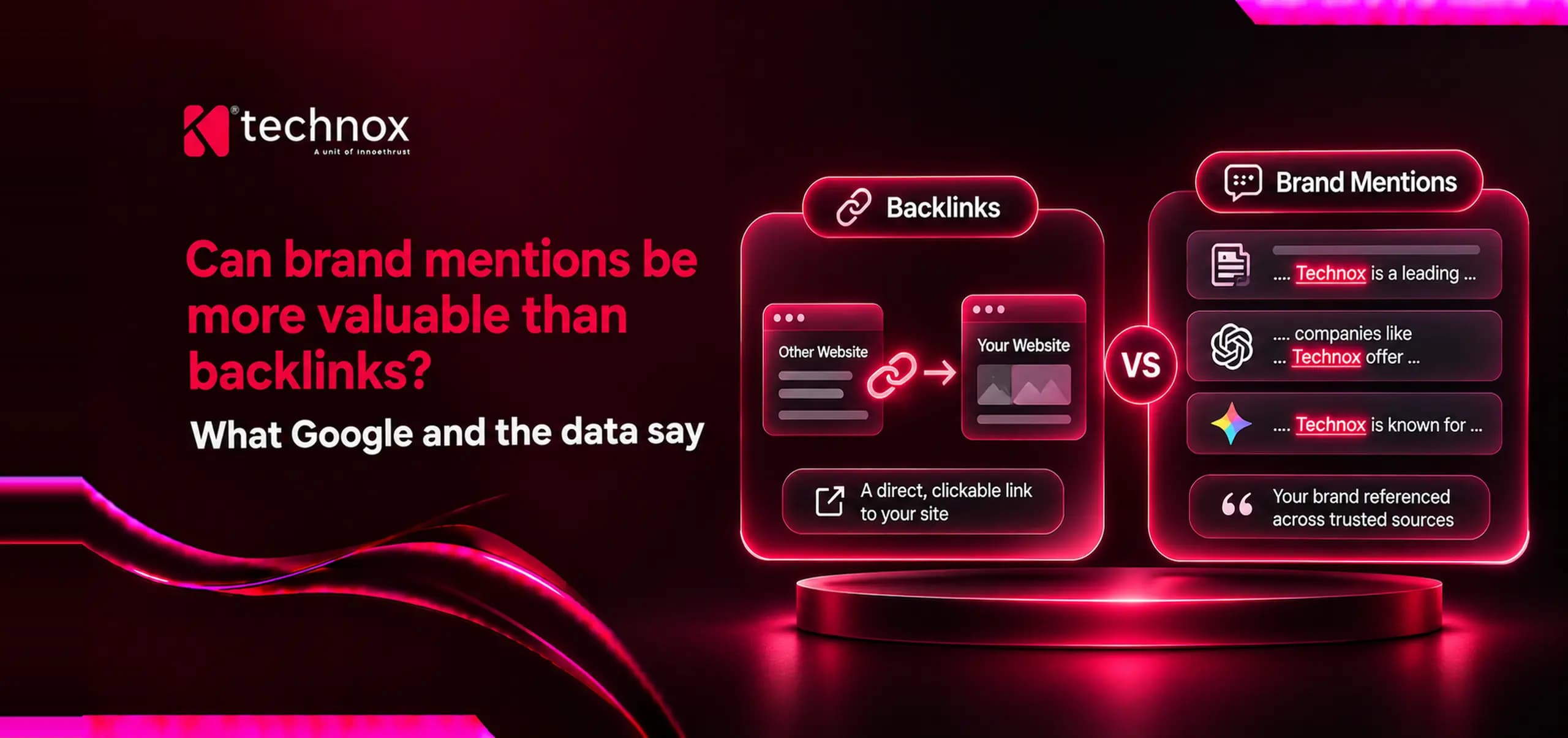
Can brand mentions be more valuable than backlinks? What Google and the data sayDigital Marketing

Can brand mentions be more valuable than backlinks? What Google and the data say

Sometimes. Brand mentions track Google's AI Overviews far more closely than backlinks do, but links still lead for Google's organic rankings and for ChatGPT citations, and the most valuable thing is a mention that also links. In Ahrefs' study of 75,000 brands, brand web mentions correlated with visibility in Google's AI Overviews at 0.664, against 0.218 for backlinks. But in the US antitrust case against Google, the court recorded that "a key quality signal is PageRank", which is built from links, and Google's John Mueller has said that, in his view, unlinked mentions "usually" do not help rankings. So the answer depends on where you want to be found.  Start with one question: where do your customers find businesses like yours today, in Google's organic results and map pack, or in answers from ChatGPT, Gemini and AI Overviews? A Coimbatore physiotherapy clinic that gets most enquiries from "physio near me" searches needs a different mix from a Tiruppur garment exporter whose buyers ask AI tools for supplier shortlists.  A note before we start: Technox sells SEO services in Coimbatore , including link building and digital PR, so we have an interest in this topic. The evidence below comes from Google's own documents and statements, court records and published studies, linked in each section.  Mentions lead for AI Overviews; links still lead for rankings and ChatGPT   A backlink is a clickable link from another website to yours. A brand mentioned is your business name on another website, with or without a link. The evidence splits by channel.  Channel Stronger signal Evidence Google organic rankings Links A 2025 US court opinion records PageRank, built from links, as "a key quality signal"; Ahrefs found referring domains correlate with rankings at 0.255 Google results for local queries Links Ahrefs found links and referring domains correlated at 0.33 for local queries, higher than for queries overall Google AI Overviews Mentions Ahrefs: brand web mentions 0.664, backlinks 0.218 across 75,000 brands ChatGPT citations Links SE Ranking found the number of referring domains was the top factor in whether ChatGPT cites a site AI mentions across platforms Link authority Semrush found its link-based Authority Score correlated with AI mentions at 0.65 across 1,000 domains The table shows the problem with "mentions beat links" as a headline. The 0.664 figure is for Google's AI Overviews only. Other studies of ChatGPT and other AI platforms found link-based measures still track closely with being cited or mentioned. Our post on whether brand authority matters for AI visibility covers the AI Overviews data in more detail.  What Google has actually said about links and mentions  We found no Google statement saying unlinked mentions count as links. Its public statements point the other way, with one interesting exception in its own explainer.  Source Date What it says Google, How Search Works Current One quality factor is "understanding if other prominent websites link or refer to the content" Google patent US8682892 Granted March 2014, now expired Defines an "implied link" as "a reference to a target resource, e.g., a citation", that is "not an express link" John Mueller, Google December 2018 A mention is picked up, "but it's not a link, it doesn't pass any PageRank" John Mueller, Google May 2020 Asked if unlinked citations help rankings: "usually not, imo" Gary Illyes, Google September 2023 As reported from Pubcon: "I think people overestimate their importance"; links are not in the top three ranking factors Pandu Nayak, Google, trial testimony October 2023 PageRank "continues to be an important signal today" US v. Google remedies opinion September 2025 PageRank "is a single signal relating to distance from a known good source, and it is used as an input to the Quality score"   Two things stand out. First, "link or refer" in Google's own explainer leaves room for mentions to count somewhere in its quality assessment, and the implied-link patent shows Google has at least designed systems that could use them. A patent is not proof that a system is in use. Second, every direct statement from Google staff and every piece of court evidence treats links as the signal that passes ranking value. Links matter less than they did, but they have not been replaced.  Ahrefs' own data agrees on the first part. In its study of the top 1 million US keywords, links correlated with rankings slightly less than they used to. A 2019 Ahrefs study of similar queries found link correlations of 0.25 to 0.29, against 0.22 to 0.24 in the January 2025 study, though Ahrefs notes the methods differed.  The most valuable mention is one that links  The comparison sets up a false choice. In Ahrefs' AI Overviews study, the second-strongest factor after web mentions was brand anchors at 0.527. A brand anchor is a link whose clickable text is your brand name. In other words, a link that names you was worth more than a plain link, and close to a plain mention.  Link type matters less than many SEOs think. Semrush found nofollow links correlated with AI mentions at 0.340, against 0.334 for followed links, and concluded that "Nofollow links have nearly the same impact as follow links". Google has treated nofollow, sponsored and ugc links as "hints" rather than rules since 2019. A nofollowed mention in a news article is not worthless.  What does lose value is a link nobody would have given you naturally. Google asks sites to mark paid links as sponsored, and such links "will generally not be followed". Earned links are not cheap either. In BuzzStream's 2026 survey of digital PR teams, the most common known cost per link was $300 to $500 (19.6% of respondents), and the share paying $750 or more rose from 3% to 10.2% in a year.  Correlation is not cause, and most of this data comes from tool vendors   Read every number above with three caveats.  They are correlations: Big, well-known brands earn mentions, links, searches and AI visibility all at once. None of these studies proves that adding mentions or links causes AI visibility.  Most come from companies that sell the tools: Ahrefs, Semrush, SE Ranking and BuzzStream all sell link or visibility products.  Rankings may matter more than either: Seer Interactive found brands on page one of Google correlated with LLM mentions at about 0.65, while backlinks showed "weak or even neutral" effects. Ahrefs found 37.9% of URLs cited in AI Overviews also appeared in the top 10 results, down from about 76% in July 2025, so ranking alone is no longer enough either.  The safe reading: earned links and earned mentions come from the same thing, being worth talking about. Chasing either as a metric misses the point.  Where to spend: mentions, links or both  The right mix depends on how your customers find you. These are starting points, not rules.  If you are Put more into Why A local service business, such as a clinic or salon in Coimbatore Foundational links first, then mentions Ahrefs found links matter more for local queries; local directories, associations and news give you both A B2B manufacturer or exporter Mentions in trade press, buyer directories and reviews When AI tools answer shortlist questions, being named matters more than being linked An e-commerce store Links to category pages, plus mentions in reviews and "best" lists Category pages still compete in organic rankings; being named in roundups puts you in front of buyers comparing options A new business with neither Digital PR that earns both One good story in local or trade media can bring a mention and a link together   For local businesses, the Ahrefs study also found internal links matter more for local queries. Our guide to internal linking for SEO covers that side, and our local SEO guide covers the rest of the map pack.  How to turn unlinked mentions into links  Converting a mention you already have can be one of the easier links to win, because the site has already chosen to write about you. In BuzzStream's 2025 survey, 83.2% of digital PR professionals said they believe Google values unlinked mentions, "but not the same as linked mentions", yet only 64% worked on converting them.  Find your mentions: Search Google for your business name while excluding your own site (for example, "Technox" -site:technox.in), set up Google Alerts for your name, or use a mention-tracking tool.  Filter for relevance: Prioritise local news, industry sites, associations and directories that your customers read. Skip low-quality pages.  Ask once, politely, with the exact page: Thank the writer, and suggest the specific page that helps their readers, not just your home page.  Accept a no: Many publications have strict no-link policies. The mention still helps with AI visibility and brand recall.  Fix the facts while you are there: If the article has your old address or phone number, ask for that correction first. Accurate mentions matter as much as linked ones. See our post on NAP consistency .  To earn new mentions rather than reclaim old ones, see our guide on getting your brand mentioned in ChatGPT, Gemini and Perplexity .  Where Technox fits  If an agency tells you links no longer matter, or that mentions are all you need for AI, ask for the evidence. Both claims oversimplify. As an AI SEO company in Coimbatore , we look at where your customers actually find you, then build the mix: earned links for rankings, earned mentions for AI answers, and as many of those as possible in the same place.  If you want to start on your own, search your business name excluding your own site this week, list every mention, and note which ones link to you. That list is your first link-building plan.  Frequently asked questions  Are brand mentions a Google ranking factor?  Not directly, as far as Google has said. John Mueller has said a mention "doesn't pass any PageRank" and that unlinked citations "usually" do not help rankings. Google's How Search Works page does say it looks at whether prominent sites "link or refer to" content as one quality factor.  Are brand mentions more valuable than backlinks for AI search?  For Google's AI Overviews, the data points that way: Ahrefs found brand web mentions correlated at 0.664 with AI Overview visibility, against 0.218 for backlinks. For ChatGPT, SE Ranking found referring domains were the top citation factor, so links still matter there.  Do backlinks still matter in 2026?  Yes. A September 2025 US court opinion records PageRank, which is built from links, as a key quality signal, and Google's Pandu Nayak testified in 2023 that it "continues to be an important signal today". Google's Gary Illyes has also said people overestimate links and that they are not a top-three ranking factor.  Do nofollow links help with AI visibility?  They appear to. Semrush found nofollow links correlated with AI mentions at 0.340, almost the same as followed links at 0.334. Google treats nofollow as a hint rather than a strict rule.  How do I find unlinked brand mentions?  Search Google for your business name while excluding your own website, set up Google Alerts for your name, or use a mention-tracking tool. Then contact relevant sites and ask them to add a link to the most useful page.  Should I stop building backlinks and focus on mentions?   No. Links still matter for Google rankings, and Seer Interactive found page-one Google rankings correlated with AI mentions at about 0.65. The best results come from earning coverage that names you and links to you at the same time. 

AI citations vs mentions: what's the difference and which one matters moreDigital Marketing

AI citations vs mentions: what's the difference and which one matters more

An AI citation is a link to your page that an AI tool shows as a source for its answer. An AI mention is your brand's name written into the answer itself. They are separate events and often happen apart: in a Semrush study of 3,981 domain appearances across ChatGPT, Gemini, AI Overviews and AI Mode, 61.7% were citations where the brand was never named, 25.1% were mentions with no citation, and only 13.2% were both. A citation can send a visit. A mention puts your name in front of the buyer. Which one you need depends on the kind of question your customers ask.  Start with one question: when someone asks an AI tool about your category, do you need them to read your name, or to click through to your page? A Coimbatore physiotherapy clinic wants to be named when someone asks for "the best physio near RS Puram". A software company publishing guides on GST e-invoicing mostly wants the click. Most businesses need both, but for different pages.  A note before we start: Technox sells AI SEO services in Coimbatore , so we have an interest in this topic. The figures below come from published studies and platform documentation, linked in each section, and we have flagged where those studies disagree.  A citation is a source link; a mention is your name in the answer  For any AI answer, your brand ends up in one of four positions.  Outcome What appears in the answer Example Cited, not mentioned Your page is listed as a source, but your brand is not named in the text An AI explains how to treat a frozen shoulder and links your clinic's blog post, without naming the clinic Mentioned, not cited Your brand is named, with no link to your site "Popular options in Coimbatore include Clinic A and Clinic B", with sources pointing to a directory Cited and mentioned Your brand is named and your page is a source The answer recommends your clinic and links your services page Neither You are absent Competitors are named and other sites are cited   Semrush calls the first outcome a "ghost citation": your content did the work, but the reader never sees your name.  One naming trap matters for local businesses. In local SEO, a "citation" also means a listing of your business name, address and phone number on a directory such as Justdial or Sulekha. That is a different thing from an AI citation, although consistent local citations and NAP details can help AI tools recognise your business when they do mention it.   Most citations do not name the brand, and most mentions have no link  Several studies in 2025 and 2026 measured how often the two overlap. Each counted differently, but they agree on the main point: being cited and being named are largely separate.  Study Finding Sample Semrush with Kevin Indig, June 2026 61.7% of appearances were cited but not mentioned; 13.2% both; 25.1% mentioned but not cited 3,981 domain appearances, 115 prompts, 14 countries, ChatGPT, Gemini, AI Overviews, AI Mode BuzzStream, June 2026 Only 23.1% of brand mentions came with a citation; 69.9% of citations also named the brand 12,000 responses across AI Mode, AI Overviews, Gemini and GPT-5.4-mini, about 200 brands Semrush AI Visibility Index, October 2026 Fewer than half of the top 100 mentioned brands were also among the top 100 cited domains, in every month studied UK and US, 22 categories, January to July 2026 Semrush, September 2025 Only 6% to 27% of the most mentioned brands were also top cited sources, depending on industry and platform 5 industries, ChatGPT and AI Mode AirOps, December 2025 Only 28% of answers included brands that were both mentioned and cited Not stated beyond "millions of datapoints"   The studies do not agree on every platform. Semrush found ChatGPT had an "87% citation rate, 20.7% mention rate" when a brand appeared, while BuzzStream found 92.7% of GPT-5.4-mini's citations also named the brand. The difference likely comes from what was counted (domain appearances versus brand mentions), the prompts used and the model version tested. Treat any single number as a description of that study, not a fixed property of ChatGPT.  Each AI platform shows citations differently  How often a platform links the brands it names varies widely. Ahrefs checked more than 31,000 mentions of its own brand from its Brand Radar database and recorded how often each platform included a link.  Platform How sources appear Share of Ahrefs mentions with a link Source Perplexity "Each answer includes numbered citations linking to the original sources" 51.60% Perplexity Help Center; Ahrefs Google AI Mode A response "with links to explore further", and sometimes only a set of web links when confidence is low 36.80% Google Search Help; Ahrefs ChatGPT Cites in 96% of responses, about 5 sources each; names the brands it cites more often than Google's tools do 26.90% Muck Rack; BuzzStream; Ahrefs Microsoft Copilot "More prominent, clickable citations", with a "Show all" option for the full list 26.10% Microsoft, November 2025; Ahrefs Gemini Cites in 82% of responses, about 8 sources each; named brands in 83.7% of appearances but cited them in 21.4% 16.80% Muck Rack; Semrush; Ahrefs Google AI Overviews The least likely of the six platforms to link a brand it names, in Ahrefs' data 10.70% Ahrefs Claude With web search on, "Every response includes citations"; in Muck Rack's data, 55% of responses had citations, averaging 13 when they did Not measured Claude Help Center; Muck Rack   The practical reading: on Perplexity, a mention usually comes with a link. On AI Overviews and Gemini, your brand is often named with nothing to click. If you only count referral visits in Google Analytics, you will miss most of your mentions on Google's own AI surfaces. Our engine-by-engine guide to AI search covers what each platform reads.  Which one matters more depends on the question being asked  The type of prompt decides which outcome is realistic. BuzzStream found that on list prompts such as "best project management tools", only 7.2% of mentions were backed by a citation. On single-brand prompts such as "Is Asana good?", the figure rose to 39.0%. In other words, when buyers ask AI tools to recommend options, the name in the list is usually all you get.  If your goal is Chase Why Being shortlisted ("best dentist in Saibaba Colony") Mentions Recommendation answers name brands and rarely link them Traffic from how-to and research questions Citations Informational content earns citations but rarely brand mentions, per Semrush Being trusted on "is X good" questions Both Single-brand prompts are where mentions and citations most often appear together Showing up repeatedly over time Both AirOps found brands that were both mentioned and cited had a 40% higher likelihood of reappearing Do not assume a citation means traffic either. In Kevin Indig's usability study of Google AI Mode, the median number of external clicks per task was zero, and 77.6% of sessions had no external visits at all. The study was small (37 participants, 250 sessions) and covered AI Mode only, but it is a useful warning: being a source is not the same as getting the visit.  Industry matters too. BuzzStream found healthcare brands had the highest share of mentions backed by citations, at 34.5%, while retail brands were named without a citation most of the time, with only 16.5% of mentions cited. For a clinic, that suggests good medical content has a better chance of being both quoted and named. For a retail store, expect most AI visibility to be name-only.  Why you get cited but not named, or named but not cited  Cited but not named usually means your content is useful but not tied to your brand in the answer. Semrush found informational content earns citations but rarely mentions, and long prompts trigger more citations but fewer brand mentions. The AI took your facts and moved on.  Named but not cited usually means other websites are talking about you. AirOps found 85% of brand mentions originate from third-party pages rather than the brand's own site. The AI picks up your name from reviews, lists, news and forums, and often cites those sources instead of your site.  Location changes the odds. In the same Semrush study (115 prompts across 14 countries), brands were mentioned in 50% of AI answers in India and Sweden, against 18% to 22% in Italy, Brazil and the Netherlands. For Indian businesses, that points to more room to be named than global averages suggest, though the sample is small.  How to measure citations and mentions separately  Track the two as separate numbers, because they move for different reasons. The tools that track AI visibility define their metrics differently, so check the formula before comparing reports.  Metric How it is usually calculated What it tells you Mention rate (visibility) Responses that mention your brand, divided by total responses (Peec AI) How often buyers see your name Share of voice Your brand's mentions as a share of all brand mentions, including yours (Peec AI, Profound) Your share of the conversation against competitors Citation share Citations pointing to your domain, divided by all citations (Profound) How much of the source material is yours Referral visits AI referral sessions in Google Analytics 4 Whether citations turn into visits   Even the headline metric differs between tools. Peec AI divides by all responses, while Profound's Visibility Score divides by "all responses that mention at least one brand", so the same answers can produce two different scores.  Write 30 to 50 prompts your customers actually ask, split into recommendation, comparison and how-to questions.  Run each prompt on the platforms your buyers use, and repeat the runs, because answers change from one run to the next.  Record four things per answer: mentioned or not, cited or not, which page was cited, and which competitors appeared.  Add the first-party data platforms give you: citation counts in Bing Webmaster Tools, AI features data in Search Console and AI referrals in GA4.  Report mention rate and citation rate side by side, with the number of answers checked.  Our guide on how to measure AI visibility walks through the full set-up, including which data each platform reports.  How to turn a citation into a mention, and a mention into a citation  Write comparison content, not only how-to content: Semrush found comparative content produced 2.4 times more brand mentions than informational content.  Put your brand name inside the facts: For pages that are cited but not named, Semrush suggests "adding clearer brand references, product mentions, or comparison sections". A passage that says "Technox audits found..." carries your name with the fact; "audits found..." does not.  Earn coverage on third-party sites: With 85% of mentions coming from third-party pages, reviews, local news, association lists and "best" roundups are how you get named. Our guide on getting your brand mentioned in ChatGPT, Gemini and Perplexity covers this step by step.  Give-named-but-uncited mentions a page to cite: If AI tools name you but cite a directory, publish the page they need: clear services, prices or ranges, areas served and credentials. That is the content ranking on ChatGPT depends on.  Keep your entity consistent: The same business name, description and details everywhere help AI tools connect a mention to your business. See our post on entity SEO .  Cover the follow-up questions: AI tools split one question into several searches, so pages that answer the related questions get more chances to be cited. Our explainer on query fan-out shows how.  Where Technox fits  If you track only one number, usually traffic, you will miss part of your AI visibility: a clinic can be named in most "best physio" answers and see no change in Google Analytics, while a content-heavy site can be cited often and never named. As an SEO company in Coimbatore that also works on AI search, we set up mention and citation tracking separately, find which pages earn citations and which third-party sources drive mentions, and then fix whichever side is weak.  If you are not sure where you stand, start with the free version: run ten of your customers' questions through ChatGPT, Gemini and Perplexity this week and note, for each answer, whether you were named, linked, both or neither.  Frequently asked questions  What is the difference between an AI citation and an AI mention?  An AI citation is a link to a page shown as a source for an AI answer. An AI mention is a brand name written into the answer text. A brand can be cited without being named, named without being cited, or both.  What is a ghost citation?  A ghost citation is when an AI tool uses your page as a source but does not name your brand in the answer. In Semrush's June 2026 study, 61.7% of domain appearances across ChatGPT, Gemini, AI Overviews and AI Mode were ghost citations.   Is an AI citation the same as a backlink?  No. A backlink is a link to your site on another website. An AI citation is a link shown inside an AI tool's answer. Both can send visitors, but a citation appears in the AI interface rather than on a web page that search engines crawl.  Are AI citations the same as local citations?  No. In local SEO, a citation is a listing of your business name, address and phone number on a directory or map service. An AI citation is a source link in an AI answer. Consistent local citations can still help AI tools recognise and mention your business.  Which AI platform links to brands most often?  In Ahrefs' analysis of more than 31,000 mentions of its own brand, Perplexity included a link 51.6% of the time and Google AI Overviews only 10.7% of the time, with AI Mode, ChatGPT, Copilot and Gemini in between. That data covers one brand, so results for your business will differ.  Do brand mentions without links still matter?  Yes. In recommendation answers, the brand name is often the only visibility on offer: BuzzStream found only 7.2% of mentions in list-style answers came with a citation. Being named puts you on the buyer's shortlist even when there is nothing to click. 

What are Entities, and Why Do They Matter for AI SearchSEO

What are Entities, and Why Do They Matter for AI Search

An entity is one specific, identifiable thing, such as a business, person, place, product or idea, as distinct from the words used to name it. AI search tools answer questions by working out which entities a question is about and what they know about each one. Google says AI Overviews work "in tandem with" its search systems and the Google Knowledge Graph, its database of entities. When an AI tool cannot tell which business you are, or knows little about you, it fills the gap, and research shows AI models are least accurate about less well-known entities. That is where most small businesses sit.  Start with one question: if you ask ChatGPT, Gemini and Perplexity "what is [your business name] in Coimbatore?", does each one describe your business correctly, or a different business, or nothing at all? The answer tells you whether AI tools recognise you as an entity yet.  A note before we start: Technox sells AI SEO services in Coimbatore , so we have an interest in this topic. This post covers how AI tools read entities and how to check what they know about you. For the step-by-step work of building your entity in Google, see our guide to entity SEO .  An entity is a thing, not a word  The word "Apple" can mean a fruit or a company. A clinic name used in Coimbatore could also belong to a different clinic in another town. Search systems deal with this by storing things rather than words: each entity gets an identity, a type and a set of facts. Google's Knowledge Graph had "over 500 billion facts about five billion entities" in 2020, the most recent figure Google has published that we could find. Wikidata, a free, openly licensed knowledge base, lists more than 124 million entities.  Entity type   Example   What AI tools need to know about it   Organisation  A physiotherapy clinic in Coimbatore  Name, category, location, services, contact details  Person  The clinic's lead physiotherapist  Name, qualifications, the organisation they work for  Place  RS Puram, Coimbatore  Where it is and what is nearby  Product or service  Sports injury rehabilitation  What it is, who offers it, the price or range  Concept  Frozen shoulder  What it means and how it relates to other entities  Google's own text-analysis tool shows how machines handle this. Its entity analysis "inspects the given text for known entities", gives each one a salience score for how central it is to the text, and where it can, attaches a Wikipedia URL and a Knowledge Graph ID. That ID is the point: once a mention is linked to one entity, everything known about that entity comes with it.  How AI search tools work out which entity you mean  In simplified form, every AI answer about a business goes through the same steps:  Recognise. The tool spots the names in the question and in the pages it reads.  Disambiguate. It decides which real-world entity each name refers to. Two clinics with the same name in different towns are different entities that share a word.  Gather facts. It pulls what it knows about that entity, from its training data, a knowledge graph or pages it retrieves.  Write the answer. It describes the entity using those facts. If step 2 went wrong, step 4 describes the wrong business confidently.  Where the facts come from differs by platform.  Platform   Where entity facts come from   Source   Google AI Overviews  A customised Gemini model working "in tandem with" Google's search, quality and ranking systems and the Knowledge Graph  Google, May 2025  Google AI Mode  "Real-time information from the web and from Google, like facts from our Knowledge Graph", plus shopping data for over 50 billion products  Google, May 2025  Microsoft Copilot  Bing's index; Microsoft's Fabrice Canel said schema markup helps Microsoft's language models understand content  Search Engine Roundtable, March 2025  ChatGPT, Gemini app, Claude, Perplexity  What the model learned in training, plus pages it retrieves when it searches the web  Our explainer on how AI search works   Google adds that AI Mode's training "encourages the model to retrieve and add additional factual information to its claims from info sources like our Knowledge Graph". For a business, that means your Knowledge Graph entry, if you have one, can feed into what Google's AI says about you.  AI tools are least accurate about the entities people know least  The research on this is consistent. Language models remember a great deal about famous entities and much less about obscure ones, and the gap does not close just by making models bigger.  Study   Finding   Sample   Head-to-Tail (Sun et al., Meta, 2023)  GPT-4 answered 40.3% of questions about the most popular entities correctly, 33.4% for mid-popularity entities and 19.0% for the least popular  18,000 questions, 16 language models  PopQA (Mallen et al., 2022 to 2023)  Models "struggle with less popular factual knowledge", and scaling "fails to appreciably improve" it; models that retrieve sources "largely outperform" much larger models that do not  14,000 questions, 10 models  FActScore (Min et al., 2023)  ChatGPT's share of supported facts in biographies fell from 80% to 16% as the people became rarer  Human-checked biographies from InstructGPT, ChatGPT and PerplexityAI  Kandpal et al., 2023  A model's ability to answer a factual question "relates to how many documents associated with that question were seen during pre-training"  Several question-answering datasets, models up to 176 billion parameters  Calderon et al., 2026  Newer models such as GPT-5 and Gemini 3 hold "95--98% of facts" in the benchmark, but recall failures "disproportionately affect long-tail facts"  4 million responses from 13 models  A Coimbatore clinic, a Tiruppur garment exporter or a Peelamedu software firm is a long-tail entity. Few documents mention it, so the model has little to go on. That is why retrieval matters: when an AI tool searches and finds clear, consistent pages about you, it does not have to rely on memory. But the FActScore study found that even the retrieval-based PerplexityAI lost accuracy on rarer people, so retrieval reduces the problem rather than removing it.  What goes wrong when AI misreads your business  Studies of AI answers about real businesses show how common the errors are.  Insites, July 2026. Insites checked ChatGPT and Perplexity answers about 10,000 US local businesses against their Google Business Profiles. Only 55.58% of ChatGPT results and 48.05% of Perplexity results matched fully. The phone number was wrong in 30.09% of ChatGPT results and 38.81% of Perplexity results.  Searchable, July 2026. More than 1,700 brands graded over 32,000 facts that AI engines gave about them. They flagged 9 in every 100 as false, and 3 in 4 brands found at least one false fact. Small businesses with 50 or fewer employees saw the highest rate, 9.4%, against 6.3% for large firms.  Searchable, London, June 2026. In tests on 165 London businesses, half of the small and medium businesses received at least one false fact, against 32% of large companies. AI tools misattributed or confused small business names at a rate of 4%, against 0.7% for large companies.  Both companies sell AI visibility tools, and the samples are from the US and UK, so treat the exact figures with care. The pattern matches the research above: smaller, less-known entities get more errors.  Problem   What it looks like   Likely cause   First fix   Confused with another business  The AI describes a same-name company in another city or country  Weak disambiguation signals: no clear location, category or linked profiles  Use your full name with your city, and link your official profiles from your site with sameAs  Outdated details  Old address, phone number, prices or services  Old pages and listings still online, or training data from before the change  Update every listing, then remove or redirect old pages  Invented details  Services you do not offer, made-up staff or prices  Too little information, so the model fills gaps  Publish the facts plainly on your site: services, prices or ranges, team, areas served  Missing entirely  The AI says it has no information, or lists only competitors  Too few sources mention you  Earn coverage on directories, local news and review sites  How to check what AI knows about your business  Run this check before changing anything, so you know which problem you have.  Check   Where   What to look for   Ask the AI tools directly  ChatGPT, Gemini, Perplexity, Copilot and Google AI Mode, in a logged-out or temporary chat  Is the description correct? Is it you or another business? Which sources are cited?  Search your brand name on Google  Google Search  A knowledge panel for your business, and whether its details are right  Check your Google Business Profile  Google Maps and Search  Name, category, address, phone and hours, which Google tells businesses to keep up to date for AI search  Check the listings AI tools can read  Justdial, IndiaMART, Practo, Sulekha or the directories for your industry  The same name, address, phone and description everywhere  Check Wikidata  wikidata.org  Whether an item exists for your business, and whether it is accurate  Use the same prompts each time: "What is [business name]?", "What does [business name] in [city] offer?" and "Who are the best [category] in [area]?". The first two test whether you are recognised. The third tests whether you are recommended. Our guide on how to measure AI visibility covers turning this into a monthly tracking routine.  A note on Wikidata: an item is accepted only if it meets Wikidata's notability policy, such as having a Wikipedia page or being "clearly identifiable" with "serious and publicly available references". Most small businesses do not need one, and creating one that gets deleted helps nobody.  How to make your entity easier for AI tools to read  The full implementation is in our entity SEO guide. For AI search, these steps matter most:  Use one name, everywhere. The same business name, written the same way, on your site, profiles and listings. Our post on NAP consistency covers the details.  Make one page the official description of you. Usually your home or about page: who you are, what you do, where, since when, and who leads the business.  Add Organization structured data with sameAs links. Google says this markup can help it "disambiguate your organization in search results", and sameAs lets you link to pages on other websites with more information about your organisation, such as your official profiles. Google also says structured data must match the visible content.  Keep Google Business Profile current. Google's guidance for AI search tells businesses to "ensure that your Merchant Center and Business Profile information is up-to-date".  Get mentioned by sources other than yourself. Google says Wikipedia is "a commonly-cited source" for its Knowledge Graph, "but it's not the only one". Local news, industry associations and reviews all count. Our guide on getting your brand mentioned in ChatGPT, Gemini and Perplexity covers this.  Name your entities clearly in your content. Write "our physiotherapists in RS Puram, Coimbatore" rather than "our team here". Every clear mention of who, what and where is something an AI tool can link.  Where Technox fits  For a small business, the entity problem in AI search is often not ranking. It is being unknown, or being mixed up with someone else, and the studies above show both happen more to smaller firms. As an SEO company in Coimbatore , we run the check above across the main AI tools, find where the wrong or missing facts come from, and fix the sources: your site, your structured data, your Business Profile and the third-party pages AI tools read.  If you want to start on your own, ask three AI tools what they know about your business today and save the answers. That record is your baseline.  Frequently asked questions  What is an entity in SEO?  An entity is a single, identifiable thing, such as a business, person, place, product or concept, that search engines store with its own identity and facts. Search engines use entities to understand what a page or question is about, rather than only matching words.  Why do entities matter for AI search?  AI search tools describe businesses using what they know about each entity. Google says AI Overviews and AI Mode draw on its Knowledge Graph. If an AI tool cannot identify your business as a distinct entity, it may describe a different business, give wrong details or leave you out.  Why does ChatGPT confuse my business with another company?  Usually because another business has the same or a similar name and the AI cannot tell you apart. Clear location and category details, consistent listings, and Organization structured data with sameAs links to your official profiles all help AI tools separate you from same-name businesses.  Why does AI give wrong information about my business?  AI tools are least accurate about less well-known entities, and small businesses have fewer sources describing them. Outdated listings, inconsistent details and gaps that the model fills with guesses are the usual causes. In Searchable's data, small businesses saw false facts at 9.4%, against 6.3% for large firms.  Does schema markup help AI understand my business?  It helps, but it is not enough on its own. Google says Organization markup can help it disambiguate your organisation, and Microsoft's Fabrice Canel has said schema helps Microsoft's language models understand content. The markup must match what is visible on the page, and AI tools still check what other sources say about you.  Do I need a Wikipedia page or a Wikidata entry?  No. Most small businesses do not meet the notability rules for either, and Google says Wikipedia is not the only source for its Knowledge Graph. Accurate profiles, consistent listings and coverage from local and industry sources matter more for most businesses.

Technical SEO for AI search: a hands-on audit to check AI bots can reach, read and use your siteSEO

Technical SEO for AI search: a hands-on audit to check AI bots can reach, read and use your site

A technical SEO audit for AI search checks three things: whether AI crawlers can reach your pages, whether they can read the content once they arrive, and whether anything on your site tells AI search not to use it. Four hidden blockers are worth checking first: a bot setting in your CDN or firewall, a robots.txt rule written too broadly, content that only appears after JavaScript runs, and snippet controls that stop Google using a page in AI answers. Most can be checked with free tools, and the eight checks below show how. Start with one question, because it catches the blocker most audits miss: when did anyone last look at your CDN or firewall bot settings? Cloudflare alone says more than one million customers had switched on its one-click AI crawler block by July 2025. If your site was one of them, that choice may still be in place. Technox offers AI SEO services and technical audits, so we have an interest in this topic. For why technical SEO decides AI visibility in the first place, read our guide to technical SEO, topical authority and AI search visibility . This post is the hands-on companion: what to check, where to click and what a pass looks like. The audit at a glance Check Where to look A pass looks like 1. CDN and firewall bot settings Cloudflare or your host's security dashboard AI search crawlers are allowed; training is a deliberate choice 2. robots.txt yourdomain.com/robots.txt No accidental block on search crawlers you want 3. JavaScript dependence Browser with JavaScript off; Google's URL Inspection Main content and prices visible without JavaScript 4. Bot verification Server logs plus published IP lists Bots claiming to be GPTBot or Googlebot come from their published IPs 5. AI bot activity Server or CDN logs You know which AI bots visit and which pages they fetch 6. Google snippet and AI controls Page source; Search Console No unintended nosnippet tags or AI opt-out 7. Structured data Rich Results Test; Schema Markup Validator Valid markup that matches visible content 8. Indexing in Google and Bing Search Console; Bing Webmaster Tools Key pages indexed in both   Check 1: Is your CDN or firewall blocking AI crawlers? This is the check most audits miss, because the setting lives outside the website. Cloudflare's history shows why it matters: • In September 2024, Cloudflare added a one-click option to block AI crawlers, and more than one million customers had turned it on by July 2025 ( Cloudflare, July 2025 ). • On 1 July 2025, Cloudflare announced it would block AI crawlers by default unless site owners chose otherwise, asking every new domain whether to allow them (same source). • In September 2026, Cloudflare added a "Disallow AI Training" setting that lets a site stay indexed for search while refusing training. It reported that fewer than 1% of Cloudflare sites block search bots, while 17% use some mechanism to block training ( Cloudflare, September 2026 ). • Cloudflare's current documentation says that for new domains, Search, Agents and Training all default to "Allow (do not block)" ( Cloudflare Docs, updated November 2026 ). So whether your site blocks AI crawlers depends on when it was set up and what someone clicked since. To check on Cloudflare, go to Security > Settings, filter by Bot traffic and open AI Crawler and Agent access policies. You will see separate actions for Search, Agents and Training. For individual crawlers, AI Crawl Control's Crawlers tab shows each one with an Allow or Block action ( Cloudflare Docs ). A sensible default for most businesses: allow Search, so AI search tools can find and cite you, and decide on Training as a separate business choice. If you use another CDN, security plugin or host firewall, look for a similar AI bot setting. We could not find a primary statement from other major providers on whether they block AI bots by default, so check yours directly. Check 2: What does robots.txt actually say? Open yourdomain.com/robots.txt and read it, rather than relying on what your SEO plugin claims. Two things to watch for: • Rules added by your CDN. If Cloudflare's Bot Preference Sync is on and any policy is set to Block or Disallow, Cloudflare generates managed robots.txt directives from those policies ( Cloudflare Docs ). Your robots.txt may contain rules nobody on your team wrote. • Rules that are too broad. A rule meant to stop a training crawler can also stop a search crawler if it names the wrong user agent or blocks everything. Our engine-by-engine guide to optimising for AI search includes a table of which crawler does what. Remember that robots.txt is a request, not a lock. Cloudflare's own documentation says "robots.txt compliance is voluntary" and that the file does not prevent crawlers from accessing content at a technical level. Blocking at the CDN or server is what actually refuses requests, and even that only works against crawlers that identify themselves honestly. Check 3: Can bots see your content without JavaScript? Google renders JavaScript. To see what Google sees, Google recommends the Rich Results Test or the URL Inspection Tool in Search Console, both of which show the rendered page, loaded resources and JavaScript errors ( Google Search Central ). Many AI crawlers do not. A 2024 Vercel analysis, reported by Search Engine Journal, found that major AI crawlers did not render JavaScript, though they did fetch JavaScript files ( Search Engine Journal, December 2024 ). Glenn Gabe's tests, first published in August 2025, found ChatGPT, Claude and Perplexity could not read content rendered by client-side JavaScript, while Google's AI Overviews and AI Mode, and Bing's Copilot, could; his October 2026 update says ChatGPT and Claude still cannot render JavaScript-based content ( GSQi, updated October 2026 ). How to check: 1. Turn off JavaScript in your browser's settings and reload your key pages. Anything that disappears, such as product details, prices, reviews or FAQs, may be invisible to many AI crawlers. 2. View the page source (not the inspected elements) and search for a sentence from your main content. If it is not in the source, it is loaded by JavaScript. 3. Run the page through Google's URL Inspection live test to confirm Google, at least, sees the rendered version. If important content depends on JavaScript, ask your developer about server-side rendering or pre-rendering for those pages. Check 4: Are the bots in your logs real? Anyone can put "GPTBot" or "Googlebot" in a user agent string. To know which visits are genuine, compare the visiting IP address with the IP ranges each company publishes: Crawler How to verify Googlebot and Google crawlers Reverse DNS lookup: the host name should end in googlebot.com, google.com or googleusercontent.com, and a forward lookup should return the same IP. Google also publishes JSON lists of its crawler IPs. OpenAI (GPTBot, OAI-SearchBot, ChatGPT-User) Compare against openai.com/gptbot.json, openai.com/searchbot.json and openai.com/chatgpt-user.json Perplexity (PerplexityBot) Compare against perplexity.ai/perplexitybot.json, which Perplexity publishes Bingbot Use Bing's Verify Bingbot tool or its published bingbot.json list This matters for two reasons. Fake bots can scrape or attack your site while pretending to be crawlers you allow. And the reverse also happens: in August 2025, Cloudflare reported that when Perplexity's declared crawlers were blocked, it saw undeclared requests using a generic Chrome browser user agent and IPs outside Perplexity's published ranges, at 3 to 6 million requests a day ( Cloudflare, August 2025 ). Perplexity disputed this, saying Cloudflare had confused it with traffic from BrowserBase, a third-party browser service it uses for fewer than 45,000 requests a day ( Perplexity, August 2025 ). Either way, user agents alone do not tell you who is visiting. One practical note: if you test access by sending a request with a bot's user agent from your own computer, you are only testing rules based on user agent. Cloudflare's free plan, for example, identifies AI crawlers by user agent string ( Cloudflare Docs ), while paid bot management uses more signals. Check 5: Which AI bots visit, and how much? Your server or CDN logs show which AI bots fetch which pages. Look for three patterns: search crawlers reaching your important pages, user-triggered fetchers (such as ChatGPT-User) appearing on pages people are asking about, and training crawlers using a large share of your bandwidth. For context, AI crawling is large and mostly not sending visitors back: • Cloudflare's 2025 review found Anthropic had the highest crawl-to-refer ratio of the leading platforms, reaching as much as 500,000 crawls per referral, while OpenAI's peaked at 3,700:1 in March 2025 ( Cloudflare Radar 2025 Year in Review ). • Training made up 22% of the crawler requests Cloudflare saw in spring 2025 and 52% by June 2026, and daily requests from AI agents grew by more than 1,700% in a year ( Cloudflare, September 2026 ). • Fastly found AI crawlers made up almost 80% of AI bot traffic between April and July 2025, with Meta generating 52% of AI crawler traffic, and 98% of real-time fetcher requests coming from OpenAI's bots ( Fastly, August 2025 ). If a training crawler is consuming heavy bandwidth with no benefit to you, that is a reason to limit it. Search crawlers and user-triggered fetchers are usually worth keeping, because they are how AI answers find and cite you. Check 6: Google's snippet and AI controls Two settings can quietly remove your pages from Google's AI Overviews and AI Mode: a nosnippet tag (or a very low max-snippet value) on a page, and the Search Console setting that opts a site out of Google's generative AI features. Search your page templates for "nosnippet" and check Search Console's settings. Our guide to optimising for AI search engines explains exactly what each control does, with Google's wording. Check 7: Does structured data validate? Run key page types, such as your home page, a service or product page and an article, through Google's Rich Results Test, which reads the rendered source code ( Google Search Console Help ), and through the Schema Markup Validator for markup Google's tool does not cover. Check that the markup matches what is visible on the page: business name, address, prices and reviews. Structured data will not get you into AI answers on its own, but wrong or broken markup gives search systems conflicting facts. Check 8: Are key pages indexed in Google and Bing? Google's AI features draw on Google's index, and several AI tools draw on Bing's. Confirm your most important pages are indexed in Google Search Console and Bing Webmaster Tools, submit an accurate sitemap to both, and use IndexNow if your platform supports it. If pages are missing, our post on why Google is not indexing your pages covers the usual causes. What about llms.txt? You do not need one to pass this audit. Google's Lighthouse tool now includes an llms.txt check, but its documentation says a missing file is marked "Not Applicable" because "providing the file is optional at the moment" ( Chrome for Developers ). Google has said its search features treat llms.txt like any other text file. If you add one, treat it as a convenience, not a fix for any of the problems above. How often to run this audit Run checks 1, 2 and 6 after any change to your CDN, security plugin, theme or SEO plugin, because those are the changes that silently add blocks. Run the full audit every quarter, and check logs (check 5) monthly if AI visibility matters to your business. To see whether the fixes improve your visibility, use our guide on how to measure AI visibility . Where Technox fits Checks 1, 2, 6 and 8 need no technical skill, only access to the right dashboards. Checks 3, 4 and 5 involve page source, server logs and IP verification, which is where most business owners hand over to a developer or agency. If you want us to run the audit, ask for a free audit or contact us . Our AI SEO services in Coimbatore page explains how we work. Frequently asked questions Does Cloudflare block AI crawlers by default? Not for new domains today. Cloudflare announced default blocking in July 2025, but its current documentation says new domains default to allowing Search, Agents and Training crawlers. Sites set up earlier, or where someone switched on the AI block, may still block them. Check Security > Settings > AI Crawler and Agent access policies in your Cloudflare dashboard. Do AI crawlers render JavaScript? Google does, for its own search and AI features. Tests and analyses found that many standalone AI crawlers, including ChatGPT's and Claude's, do not render JavaScript. Content that only appears after JavaScript runs may be invisible to them, so key text, prices and FAQs should be in the page's HTML. How do I check if AI bots can crawl my site? Check your CDN or firewall bot settings, read your robots.txt, view your key pages with JavaScript turned off, and look at your server logs for visits from crawlers such as OAI-SearchBot, PerplexityBot and Bingbot, verified against their published IP ranges. How do I know a visit is really from GPTBot or Googlebot? Compare the visiting IP address with the IP lists the companies publish, such as OpenAI's gptbot.json and searchbot.json, or run a reverse DNS lookup for Googlebot. A user agent string alone can be faked. Do I need an llms.txt file for AI search? No. Google's Lighthouse treats a missing llms.txt file as not applicable because the file is optional, and Google has said its search features treat llms.txt like any other text file. Fixing crawler access, rendering and indexing matters far more. Should I block AI training crawlers? It is a business decision, separate from search. Blocking training crawlers keeps your content out of future model training, while allowing search crawlers keeps you eligible to be cited in AI answers. Cloudflare now offers a "Disallow AI Training" setting that keeps search indexing while refusing training.